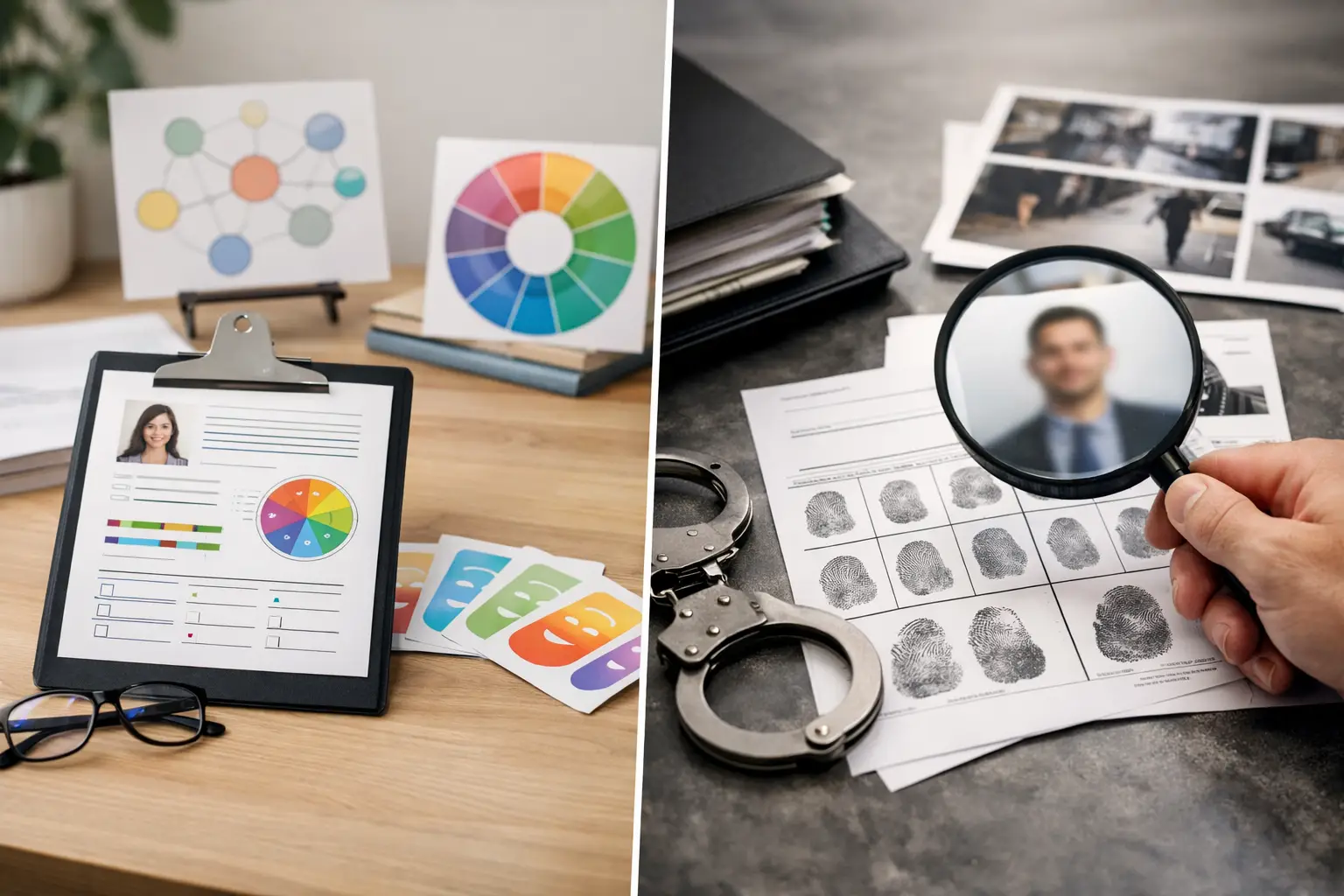
A resume looks clean. The interview goes well. References sound fine. Then the real question shows up: are you trying to verify facts, or are you trying to understand the person behind them? That is the heart of the personality report vs background check decision, and mixing up those two tools leads to bad hires, weak team fit, and false confidence.
These tools are not interchangeable. One is built to confirm what happened in someone’s past. The other is designed to surface how someone is likely to think, respond, relate, and perform. If you use a background check when you actually need behavioral insight, you will get a legally useful document that tells you very little about day-to-day fit. If you use a personality report when you need hard verification, you will get interpretive insight that cannot replace due diligence.
Personality report vs background check: the core difference
A background check is a verification tool. It looks backward. Depending on the scope, it may confirm identity, criminal records, employment history, education, credit-related information where allowed, driving records, or other public and authorized data points. Its job is simple: reduce factual risk.
A personality report is an interpretation tool. It looks at patterns of behavior, temperament, emotional tendencies, communication style, and likely compatibility with certain roles or people. Its job is different: reduce people-reading uncertainty.
That distinction matters more than most teams admit. A background check can tell you whether someone’s stated history is accurate. It cannot tell you whether they are naturally decisive under pressure, avoid conflict, dominate meetings, shut down after criticism, or thrive in highly collaborative environments. A personality report can help with those questions. It cannot tell you whether a credential is real or whether a record exists.
If you hire, coach, manage, or build teams, this is not a technical distinction. It is an operational one.
What a background check does well
Background checks are built for verification, compliance, and risk control. That makes them essential in many professional settings. If you need to know whether the basics are true, this is the right instrument.
It is especially useful when the stakes involve trust, safety, financial responsibility, regulatory requirements, or access to sensitive systems. In those cases, you do not want a narrative. You want confirmed information.
That said, many decision-makers quietly expect too much from background checks. They see a clean report and assume character, judgment, and team fit are also clean. That leap is where mistakes happen. A background check can remove some red flags. It does not reveal how a person actually operates once they are in the room.
A verified past is not the same thing as a predictable working style.
What a personality report does well
A strong personality report is designed to decode the human side of a decision. It helps you move beyond polished self-presentation and into deeper pattern recognition. That is useful in hiring, team building, leadership coaching, relationship dynamics, and career discussions.
For many professionals, this is the missing layer. They can verify credentials, but they still struggle to read energy, motivation, consistency, emotional pressure points, and interpersonal style. That is where a personality-focused system becomes powerful.
The value is speed and structure. Instead of relying only on instinct, you get a cleaner framework for understanding likely tendencies. That can sharpen interview questions, improve role alignment, and make difficult people decisions less vague.
This is also why consumer-facing personality tools have grown beyond casual curiosity. People want fast signal. Managers want a tighter read on fit. Coaches want language for patterns they can already sense but have not fully named. Teams want a shared reference point that feels more concrete than gut feeling.
In that context, a guided AI personality report can be especially appealing because it turns abstract impressions into a polished, readable analysis. A platform like SomaScan.ai positions that process as a structured scan rather than an open-ended opinion, which is exactly why it resonates with users who want speed, clarity, and something they can actually review and share.
Personality report vs background check in hiring
Hiring is where this comparison gets practical fast. If you are screening a candidate, a background check answers, “Is this information legitimate?” A personality report helps answer, “What kind of person are we bringing into this team?”
Those are separate questions, and both matter.
If the role involves compliance, financial exposure, security access, vulnerable populations, or legal obligations, a background check may be non-negotiable. But even when that report comes back clean, the hardest hiring failures usually come from behavior, not paperwork. The candidate may be highly qualified and still create friction, avoidance, rigidity, poor communication, or culture mismatch.
That is why personality insight is often more predictive of the lived experience of working with someone. Not always, and not in a perfect way, but often. It gives context that a historical record simply cannot.
The trade-off is straightforward. Background checks are stronger on objective verification. Personality reports are stronger on interpretive insight. One reduces factual risk. The other reduces relational and performance uncertainty.
The best hiring process understands that these are different categories of risk.
When one is enough and when it is not
If you are renting to a tenant, authorizing access to sensitive infrastructure, or meeting a regulated screening requirement, a personality report is not a substitute for a background check. That should be obvious, but it is worth stating clearly.
If you are deciding whether two people will work well together, whether a candidate’s style matches a high-conflict sales floor, or whether someone is better suited for independent execution versus collaborative leadership, a background check will not get you there.
In lower-risk consumer or professional contexts, some people do not need hard verification at all. They want insight, not investigation. They are trying to understand dating compatibility, management style, career direction, or interpersonal blind spots. In those cases, the personality report is often the main event, and the background check is irrelevant.
Why people confuse these tools
Part of the confusion comes from the word report. Both outputs look official. Both can arrive as polished documents. Both can influence judgment. That surface similarity hides a major difference in purpose.
Another reason is that decision-makers often want one tool that does everything. They want certainty in a PDF. But people decisions do not work that way. Verification and interpretation are two different engines.
The smarter move is to ask what kind of uncertainty you are trying to reduce. If the uncertainty is factual, use a background check. If the uncertainty is behavioral, use a personality report. If both kinds of uncertainty matter, pretending one tool can cover both is where the process breaks.
The real risk of choosing the wrong tool
The cost is not just inefficiency. It is false confidence.
A clean background check can make a weak fit look safe. A compelling personality report can make an unverified story sound trustworthy. In both cases, the document appears to answer more than it actually does.
That is why strong operators separate insight from verification. They do not force one tool into the job of the other. They build a clearer decision stack.
For recruiters and managers, that may mean using personality insight earlier to shape interviews and team-fit discussions, then using background screening later for validation where appropriate. For coaches or individuals, it may mean skipping verification entirely and focusing on a deeper read of emotional patterns, compatibility, and working style.
The right sequence depends on the stakes. But the logic stays the same.
Which one should you use?
Use a background check when you need confirmed facts about identity, history, or risk exposure. Use a personality report when you need a sharper read on behavior, compatibility, emotional tendencies, or likely style under pressure.
If you are making a serious people decision, the better question is not personality report vs background check as if one must win. The better question is what kind of answer you need first.
When the goal is compliance, trust but verify. When the goal is understanding a person at a deeper level, verify all you want - it still will not tell you how they think, connect, and respond when the pressure is real.
The strongest decisions come from using the right lens for the right problem. That is how you stop confusing a clean record with clear insight.