Most people aren’t bad at reading people. They’re just operating with low signal.
You get a profile photo, a quick handshake, maybe five minutes of small talk - then you’re expected to guess temperament, stability under pressure, leadership style, conflict patterns, and whether someone is going to fit the room. That’s a lot of inference on a tiny sample.
An AI face read tool exists for one reason: to turn a face into structured signal fast. Not “vibes.” Not a horoscope. A formatted, repeatable breakdown that feels like a professional report - the kind you can reference, compare, and share.
This topic attracts two types of buyers. The first is the curious consumer who wants a high-confidence narrative about themselves or someone close to them. The second is the professional who wants quicker people-reading for hiring, collaboration, coaching, or client dynamics without running a full battery of assessments.
Both groups ask the same question, just in different language: what can an AI face read tool actually tell you, and how do you use it without fooling yourself?
What an AI face read tool is actually doing
The words “face reading” trigger strong reactions because people conflate three very different things.
One is simple computer vision: detecting a face, estimating landmarks, measuring ratios, and classifying expressions. Another is identity: recognizing who a person is, verifying they match an ID, or finding their public images. And the third is inference: using facial structure, presentation cues, and expression patterns to generate a personality-style narrative.
An AI face read tool is the third category - but it borrows the first two to get there.
At a practical level, most systems follow the same chain:
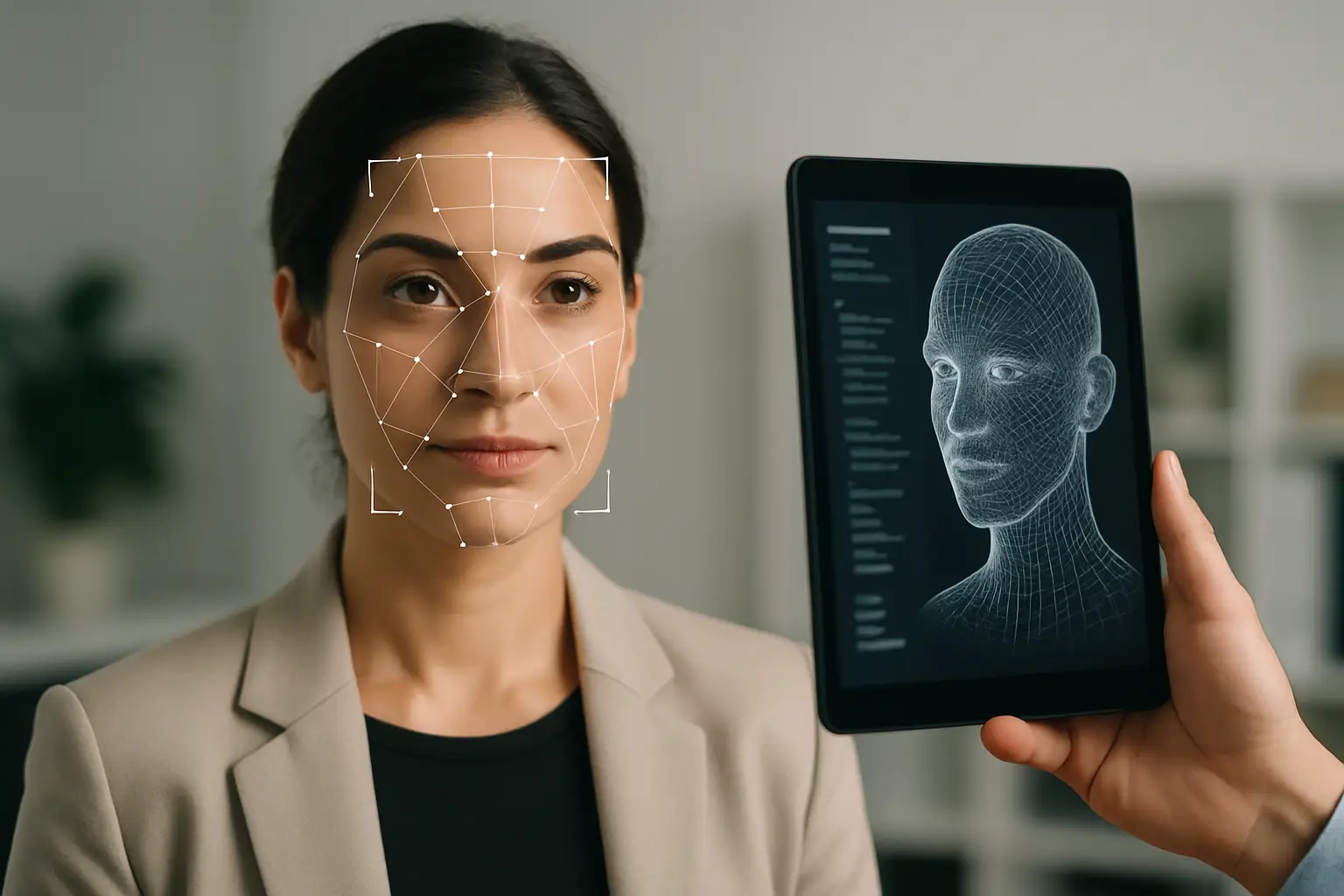
The tool detects a face and maps geometry. It identifies landmark points around the eyes, brows, nose, mouth, cheeks, and jawline. It estimates proportions and symmetry. It looks for tension and relaxation patterns in key zones (eyes, mouth corners, brow). And if multiple images or angles are provided or discovered, it attempts to reduce the “bad photo problem” by averaging signals across a set.
Then comes feature encoding. The system converts what it sees into a vector representation - numbers that capture the shape, texture, and expression characteristics. That vector can be compared against learned patterns from training data.
Finally, the tool generates output. This is where face reading tools diverge.
Some tools stay conservative and only report what they can measure: emotion likelihoods, expression states, age range estimates, head pose, or attractiveness proxies. Others take the bigger leap: they translate facial structure and presentation into trait language - things like assertiveness, agreeableness, risk tolerance, openness, emotional intensity, relational style, and stress patterns.
That leap is what people are paying for. They don’t want a list of pixel-level measurements. They want a structured, confident profile.
Why the “face to personality” jump is so controversial
If you’re evaluating an AI face read tool, you need to understand the core tension: faces contain information, but not in a clean one-to-one way.
A face is not a personality test. At the same time, it’s also not random noise.
Humans do this instantly. We infer. We predict. We categorize. We decide if someone feels warm, controlled, reactive, intense, playful, guarded, dominant, or easygoing based on micro-cues and structure cues. That isn’t mystical. It’s social cognition.
The controversy is about accuracy claims and misuse.
One problem is overreach: promising that a face alone can deterministically reveal a complete psychological profile with zero uncertainty. That’s where skepticism is justified. Personality is shaped by temperament, upbringing, culture, experiences, self-control, and context. Facial structure might correlate with some patterns in certain datasets, but it doesn’t “cause” someone’s integrity or loyalty.
Another problem is bias: if the training data is unbalanced or the labeling is subjective, the model can learn distortions. A tool might confuse cultural expression norms with “coldness,” or interpret certain styling choices as “dominance.”
A third problem is the “authority effect.” When output arrives as a clean report, people treat it like a lab result. That’s dangerous if the report is used as a final verdict rather than a lens.
The useful stance is neither blind belief nor automatic dismissal. The useful stance is: this is a signal amplifier. It can help you notice patterns, ask better questions, and compare impressions - but it should be used like a decision-support tool, not a judge.
What the best AI face read tools try to deliver
The market has a lot of “toy” experiences: upload a selfie, get a couple adjectives, share it on social media, move on. That’s entertainment.
The serious demand is for something else: a report that feels like a professional-grade breakdown. Buyers want architecture, not adjectives.
A strong AI face read tool tends to deliver four categories of output.
First is trait structure. Not just “confident,” but how confidence manifests: through directness, risk appetite, leadership posture, and communication style. It separates charisma from steadiness, intensity from dominance, warmth from compliance.
Second is emotional patterning. How someone likely processes pressure, how quickly they escalate, whether they internalize stress, whether they reset fast, and what triggers defensiveness.
Third is compatibility dynamics. How two patterns interact - for example, an intense, fast-deciding profile paired with a reflective, harmony-seeking profile. Compatibility here isn’t “soulmate” talk. It’s friction mapping: where misunderstandings happen, where complementarity is real, and what agreements make the relationship stable.
Fourth is situational fit. Certain patterns thrive in certain environments. Sales roles reward social energy and resilience. Compliance-heavy roles reward control, patience, and conscientiousness. Team leads need conflict tolerance and clarity. A face read tool that can translate pattern language into environment fit is the one people keep.
If you’re wondering what a finished report experience typically includes, you can also see a breakdown of the deliverable format here: AI Face Reading Reports: What You Really Get.
How an AI face read tool works in practice (the workflow)
The best experiences are guided because buyers don’t want technical choices. They want a clean runway: start, scan, report.
In practice, the workflow usually looks like this.
You anchor identity. Some platforms start with a name or a unique identifier, not because the AI “needs” a name to see the face, but because the product is built around a person record. That anchor makes the report feel like a dossier rather than a generic reading.
You provide images or allow discovery. A strict tool asks for a selfie or uploaded images. A more automated tool can attempt profile and image discovery (within the limits of what’s available and what the user authorizes). The goal is to reduce variance: one photo can be misleading, but a small set reveals steadier structure cues.
The system runs a scan. Under the hood, this may include face detection, landmark mapping, pose normalization, quality checks, and feature aggregation. It may also assess whether an image is too blurry, too angled, too filtered, or too heavily edited to be reliable.
Then the output is generated as a structured report. High-performing products don’t dump raw probabilities. They package results into sections, frameworks, and named modules. The frameworks are partly marketing, but they also serve a real function: they force consistency in output and make the report easier to interpret.
Finally, the report is delivered in a shareable form - often PDF-ready - because the output isn’t just for the buyer. It’s for a manager, partner, coach, or teammate.
The signals these tools commonly read (and what they map to)
Different tools describe signals differently, but most “face reading” engines are drawing from the same observable categories.
Structural geometry (bone and proportion cues)
This includes jaw width, chin prominence, cheekbone structure, facial width-to-height ratio, forehead height, eye spacing, and overall symmetry.
Tools often map these cues to language like drive, decisiveness, persistence, control, and dominance. The risk is oversimplification. A strong jawline does not equal leadership. But when combined with other cues and repeated across multiple images, these features can feed a plausible profile narrative.
The more responsible tools frame this as tendency language, not destiny language.
Soft tissue and expression baseline
This is where a lot of practical “people reading” lives.
Resting tension around the mouth can suggest guardedness or control. Brow tension can correlate with intensity, vigilance, or mental load. Eye openness and lid tension can correlate with reactivity or calm.
But there’s a catch: baseline expression varies with sleep, stress, lighting, and even allergies. A tool that treats a single tired selfie as someone’s permanent temperament will mislead you.
Better systems either average multiple images or include confidence statements about image quality.
Micro-expression patterns (when video or multiple images are used)
Some platforms incorporate multi-image sequences or short video inputs. This allows a tool to estimate how often someone shows certain expressions, how fast they shift, and what their “reset time” looks like after a smile or a frown.
This category is much closer to observable behavior. It’s still not a full psychological assessment, but it can support claims about emotional dynamism, expressiveness, and social signaling.
Presentation cues (grooming, styling, posture)
Tools may incorporate hairstyle, facial hair, makeup, accessories, and head posture as secondary cues. This is controversial because presentation is a choice and heavily cultural.
Still, in professional contexts, presentation is part of the signal. People do use it to communicate identity. The problem is when an AI treats presentation as fixed character rather than situational strategy.
If a tool is mature, it will treat presentation cues as context modifiers, not core traits.
What these tools can be good for (real use cases)
The reason people keep paying for AI face read tools is simple: they reduce uncertainty fast.
Not perfectly. Not always. But faster than intuition alone.
Hiring and recruiting triage
In hiring, the cost of being wrong is high. The problem is that many hiring teams still rely on unstructured interviews and “gut feel.”
An AI face read tool, used responsibly, can serve as a pre-interview lens. It can suggest what to probe.
If a profile reads as highly decisive and control-oriented, you can test for flexibility and collaboration, not because the person is “bad,” but because that’s where friction often appears. If a profile reads as harmony-seeking and emotionally attuned, you can test for conflict tolerance and boundary-setting.
This doesn’t replace interviews. It makes interviews sharper.
Team fit and collaboration dynamics
Managers constantly deal with invisible mismatches: one person wants speed, another wants certainty. One wants direct feedback, another wants diplomacy. One thinks out loud, another thinks privately.
A face read report can give a team a shared language for these differences. It can reduce moralizing. Instead of “you’re difficult,” it becomes “you move fast and you like control - let’s set rules so decisions don’t feel chaotic to others.”
Coaching and communication tuning
Coaches and consultants often need to adapt their style to the client quickly.
If a report suggests a person is more guarded and control-driven, you don’t push vulnerability as the first move. You establish competence and respect. If a report suggests emotional intensity, you emphasize regulation, boundaries, and decision pacing.
The point isn’t to stereotype. It’s to enter the conversation with fewer blind spots.
Relationship compatibility and conflict mapping
People buy face reading for relationships because they want an answer to one question: why do we keep having the same argument?
Compatibility output is useful when it is framed as interaction patterns.
A common mismatch is intensity versus stability. Another is autonomy versus closeness. Another is blunt honesty versus harmony maintenance.
A good AI face read tool doesn’t just say “you two are compatible” or “not compatible.” It calls out pressure points and suggests what agreements make the pairing work.
Personal clarity and self-leadership
The individual user wants language. They want a mirror.
A structured report can help someone see themselves in a way that feels organized, even if it’s not perfect. The best outcome is not blind belief. The best outcome is better self-management: knowing what triggers you, what you overuse, what you avoid, and what environments bring out your best.
Where an AI face read tool fails (and how to spot it)
A real buyer doesn’t just want upside. They want to avoid wasting money and making dumb decisions.
Here’s where face reading tools typically fail.
Single-image certainty
If the experience relies on one photo and delivers extremely specific claims with no caveats, treat it as entertainment.
Lighting, camera distortion, filters, and angle can change the geometry enough to skew the reading. A serious tool tries to mitigate this through multiple images, quality checks, or at least clear guidance about what input works.
Generic output that could fit anyone
Some tools generate flattering, broad statements that feel accurate because they’re non-falsifiable.
The tell is that the report has no friction. It’s all strengths, no trade-offs.
Real traits come with costs. High drive often comes with impatience. High empathy often comes with over-responsibility. High control often comes with rigidity. If the report doesn’t include trade-offs, it’s likely not doing real patterning.
Moral language instead of pattern language
If a tool labels someone as “good,” “bad,” “trustworthy,” or “untrustworthy,” that’s a red flag.
A face can’t ethically justify a moral verdict. Pattern language is acceptable: “more guarded,” “more intense,” “more agreeable,” “more independent.” Moral judgment is not.
Hidden manipulation tactics
Some products use face reading as a front for aggressive upsells, vague subscriptions, or paywalls that feel like a trap.
The best products are straightforward: you know what you’re buying, how long it takes, and what the report contains.
Accuracy, validity, and the question everyone asks
People want a number. “How accurate is it?”
That’s not a simple answer because it depends on what you mean by accurate.
If you mean “does it identify the same person,” that’s identity recognition, not face reading.
If you mean “does it correctly label a momentary emotion,” that’s expression classification. Those systems can be fairly strong in constrained conditions, and weaker in real-world conditions.
If you mean “does it correctly infer stable personality traits,” now you’re in the hardest category.
Personality is usually measured through self-report inventories, observer reports, and behavioral outcomes across time. A face read tool is an indirect method. It may correlate with certain patterns, but it cannot deliver clinical-grade certainty.
So what should you demand?
You should demand internal consistency and useful specificity.
Internal consistency means the report doesn’t contradict itself. It doesn’t call someone “highly impulsive” and “extremely controlled” in the same breath without explaining context.
Useful specificity means it predicts where friction occurs and what helps. Even if it’s not perfect, it should make your next conversation more targeted.
The evaluation question that matters is: did this tool help you ask better questions and make better decisions, faster?
How to use an AI face read tool without embarrassing yourself
This matters if you’re a manager, recruiter, or coach. You’re dealing with people, not avatars.
A face read report should be treated like a hypothesis generator.
If the report says someone has a control-oriented core, you don’t tell them “the AI says you’re controlling.” You ask questions about decision-making and uncertainty. You observe how they handle pushback. You look for confirmation or disconfirmation.
If the report suggests emotional intensity, you don’t assume volatility. You ask about stress response, how they prefer feedback, and what helps them stay grounded.
If you’re using it in a team context, the safest approach is to use it on yourself first. That demonstrates humility and reduces the sense of surveillance.
And if you’re using it in hiring, do not treat it as a pass/fail gate. Use it as a prompt for structured interviewing.
The ethical line: what’s fair game, what isn’t
Face reading sits on a boundary. Used well, it’s insight. Used badly, it becomes discrimination.
The ethical line is easier to hold than people think.
It is fair to use a tool to improve communication, self-awareness, and interpersonal strategy. It is fair to use it to reflect on compatibility patterns. It is fair to use it as a coaching aid.
It is not fair to use it as the sole reason to deny someone an opportunity. It is not fair to present the report as a medical or clinical diagnosis. It is not fair to treat it as proof of moral character.
If you’re a professional, the simplest standard is this: if you wouldn’t say it based on a 10-minute conversation, you shouldn’t say it based on a face scan.
What to look for when choosing an AI face read tool
Most buyers don’t need to compare 20 products. They need a short list of criteria that prevents bad purchases.
A guided input process
A good tool tells users what works: front-facing photos, neutral lighting, minimal filters, multiple angles when possible. It doesn’t punish people for not being photographers, but it does set standards.
A structured, repeatable framework
Random adjective generators feel fun, then disposable.
The tools that stick use a structured methodology. They break personality into cores, axes, or elements. They name modules. They version their approach. This does two things: it forces the engine to produce consistent categories, and it makes the output legible to humans.
Trade-offs and pressure points
If the report reads like a compliment sandwich, it’s not doing analysis.
You want a report that calls out where the pattern breaks under stress, how someone behaves when tired, and what triggers reactive loops.
A shareable deliverable
If you’re buying for professional use, you want a PDF-ready report that looks clean in a meeting, coaching session, or team workshop.
Clear boundaries
A serious tool tells you what it does and what it doesn’t do. It doesn’t claim to be a therapist. It doesn’t claim to “prove” integrity. It stays in pattern language.
Why people crave this kind of tool right now
The popularity of face reading tools isn’t random hype. It’s a response to modern life.
Work moved remote. First impressions became digital. Dating became profile-driven. Teams became distributed. People got flooded with information and lost patience for ambiguity.
At the same time, formal assessments are slow. They require buy-in, time, and sometimes a trained facilitator. Many people will never complete them.
So the market pulled a tool into existence that does what people want: quick, confident narratives with a professional finish.
There’s also a second driver: the collapse of shared social context.
In previous decades, you could infer someone’s norms from community, family, or local culture. Today you’re dealing with strangers from different regions, industries, and backgrounds. The old intuition rules don’t always transfer. A tool that claims to stabilize first impressions becomes attractive.
The real-world best practice: combine face reading with one other signal
If you want to use an AI face read tool at a higher level, pair it with one additional input.
For professionals, the clean pairing is a structured interview. Let the report generate hypotheses, then validate them with consistent questions.
For relationships, pair it with conflict history. Look at the last three arguments: what triggered them, how each person reacted, how repair happened. Then see if the report explains that loop.
For personal growth, pair it with journaling. If the report claims you avoid conflict but crave clarity, track how often you delay hard conversations and what it costs you.
This simple pairing turns a “cool report” into an operating system.
How an AI face read tool fits into hiring without creating legal headaches
If you’re a recruiter or hiring manager in the US, you already know the risk: anything that looks like discriminatory screening is a problem.
Using face analysis tools in hiring should be handled with restraint and clarity.
The safest position is to use the tool internally as a communication lens, not as a gating mechanism. If you use it at all, use it after an initial screen based on resume and role requirements, and only to shape interview questions.
Avoid recording sensitive inferences. Avoid labeling someone with mental health language. Avoid using it as an “objective score.”
If your organization has compliance processes, run the idea through them. If you don’t, the minimal standard is to document that the tool is not used to make final decisions, and that any insights are treated as hypotheses.
This isn’t about being timid. It’s about not confusing a pattern engine with a legal hiring instrument.
What the report should sound like (and what it shouldn’t)
A high-quality face read report has a specific voice.
It should be assertive but not absolute. It should be specific but not creepy. It should be structured but not robotic.
It should sound like this:
“This profile shows a strong control orientation under uncertainty. The upside is clarity and decisiveness. The pressure point is rigidity when feedback feels like loss of authority. Best communication: direct, respectful, with options.”
It shouldn’t sound like this:
“You are controlling and can’t handle criticism.”
The difference is the difference between pattern intelligence and judgment.
The “compatibility” feature: what it can and can’t do
Compatibility is one of the highest-converting promises in this space, and it’s also one of the easiest to oversell.
A tool can help map interaction style. It can predict where two people will misunderstand each other. It can suggest the agreements that stabilize the pairing.
It cannot guarantee longevity. It cannot account for shared values, trauma history, life timing, or willingness to grow.
If you’re using compatibility for relationships, treat the report as a translator.
If it says one person is fast, direct, and intensity-driven, and the other is cautious, harmony-seeking, and sensitive to tone, the value is immediate: you now know the argument isn’t about the dishes. It’s about pace and tone and control.
If you’re using it for teams, compatibility is about friction budgeting. You can tolerate a lot of difference if roles are clear and decision rights are explicit. You can tolerate very little difference if roles are ambiguous.
A good tool will implicitly teach you that.
Why framework naming matters more than people admit
You’ll notice that the best face reading products don’t just say “analysis.” They name their analysis.
They use versioning. They use module labels. They use system language.
Some buyers roll their eyes at this. They assume it’s pure marketing.
It is marketing, but it’s also product discipline.
When a tool is forced into a named framework, it becomes easier to compare outputs across people. It becomes easier to build reports that don’t drift. It becomes easier to build user trust because the categories repeat.
If you’re using face reading professionally, you want that repeatability. You don’t want a different style of report every time.
How to get cleaner results from your inputs
If you want an AI face read tool to produce a cleaner read, you don’t need a studio shoot. You need basic discipline.
Use a front-facing image with neutral lighting. Avoid harsh shadows that carve the face into exaggerated geometry. Avoid wide-angle distortion from holding the camera too close. Avoid beauty filters, heavy smoothing, and face-altering edits.
If the tool allows multiple images, provide them. A neutral expression plus a slight smile plus a candid angle often gives a more stable view than a single posed photo.
If you’re scanning someone else, use publicly available, consistent images that represent them accurately. Don’t use one extreme expression or one low-quality screenshot and then act surprised when the report feels off.
The professional use case nobody talks about: conflict de-escalation
Here’s where these tools can be surprisingly effective: they can stop teams from moralizing each other.
Most workplace conflict escalates because people attribute intent.
“He’s trying to dominate.”
“She’s trying to undermine me.”
“They don’t care.”
A face read tool reframes this into pattern differences. That doesn’t excuse bad behavior, but it reduces paranoia.
If a report suggests someone is high-intensity and high-control, you can build guardrails: decision frameworks, turn-taking rules in meetings, explicit escalation paths. If a report suggests someone is harmony-driven and conflict-avoidant, you can build safety: written agendas, pre-briefs, and private channels for dissent.
This is not therapy. It’s systems design for human behavior.
The consumer use case nobody admits: narrative relief
People also buy these tools because it feels good to have a coherent story.
When someone can’t explain why they keep choosing the wrong partner, or why they keep burning out in certain roles, they don’t just want tips. They want a model of themselves.
A face read report can deliver that model quickly.
Sometimes it’s validating. Sometimes it’s confronting. The best reports don’t just flatter. They call out the loop.
“High drive, high expectations, low patience for ambiguity. Upside: you build fast. Cost: you exhaust people and yourself.”
That kind of clarity is why people share these reports.
A note on privacy and consent (especially for professionals)
If you’re scanning yourself, the consent question is easy.
If you’re scanning other people, be careful.
In a professional setting, scanning employees or candidates without consent can break trust fast, even if it’s technically possible. In personal settings, scanning a partner or friend without telling them can turn a curiosity tool into a surveillance tool.
If you want the benefits without the blowback, keep it simple: be transparent. Use the report as a conversation starter, not a secret weapon.
Where this category is going next
Face reading tools are moving in two directions at the same time.
One direction is more inputs: multi-angle scanning, short video capture, voice tone correlation, and behavior-based check-ins. The goal is higher confidence by triangulation.
The other direction is better packaging: clearer frameworks, cleaner reports, compatibility matrices, and professional-ready formatting.
The winning products will be the ones that do both while holding the ethical line. People want confidence, but they don’t want creepiness. They want speed, but they don’t want nonsense.
What a high-confidence “engine” experience looks like
If you’re looking for the product experience that buyers tend to prefer, it usually has these characteristics: you start with identity anchoring, you get guided discovery or upload, the system runs a named scan, and you receive a polished, PDF-ready report with modular sections that read like a professional assessment.
That’s the difference between a novelty generator and an engine.
For readers who want that engine-style workflow specifically, SomaScan.ai positions itself as a consumer-facing AI facial analysis platform built around a guided scan and a structured report framework designed for shareable, professional-grade output.
FAQ: AI face read tool questions people actually ask
Is an AI face read tool the same thing as facial recognition?
No. Facial recognition is about verifying or identifying who someone is. A face read tool is about generating trait and pattern insights from facial cues. The underlying computer vision can overlap, but the purpose and output are different.
Can these tools diagnose mental health conditions?
They shouldn’t. A face reading report is not a clinical diagnosis and shouldn’t be treated like one. If a product claims to diagnose disorders from a photo, that’s a credibility problem, not a feature.
Are results always accurate?
Results are variable. Input quality, image diversity, and the tool’s methodology all affect the read. The most useful way to treat the output is as a hypothesis: something to validate through conversation and observed behavior.
What kind of photo gives the best results?
Use a clear, front-facing photo with neutral lighting and minimal filters. If the tool accepts multiple images, include a few that show different natural expressions. Avoid extreme angles and heavy edits.
Can I use this for hiring decisions?
If you’re a professional, don’t use it as a pass/fail gate. If you use it at all, use it as an internal lens to shape interview questions and communication strategy. Treat it like decision support, not a hiring instrument.
Why do some reports feel generic?
Because some tools generate broad statements that apply to almost anyone, or they over-optimize for flattery. Better tools include trade-offs, pressure points, and behavior-level suggestions that create falsifiable specificity.
What does “compatibility” mean in these reports?
It usually means interaction style compatibility: how two people’s patterns reinforce or clash. It can highlight friction points and repair strategies. It can’t guarantee long-term success because values, life context, and growth matter.
What should I do if the report feels wrong?
First, check input quality. A low-quality, filtered, or distorted image can throw off a scan. Second, treat the report as a lens, not a verdict. If a section doesn’t fit, ignore it and focus on the parts that produce useful questions and better conversations.
If you’re going to use an AI face read tool, use it the way the smartest professionals do: as a fast pattern mirror that sharpens your questions, not as a final label you slap on a human being.