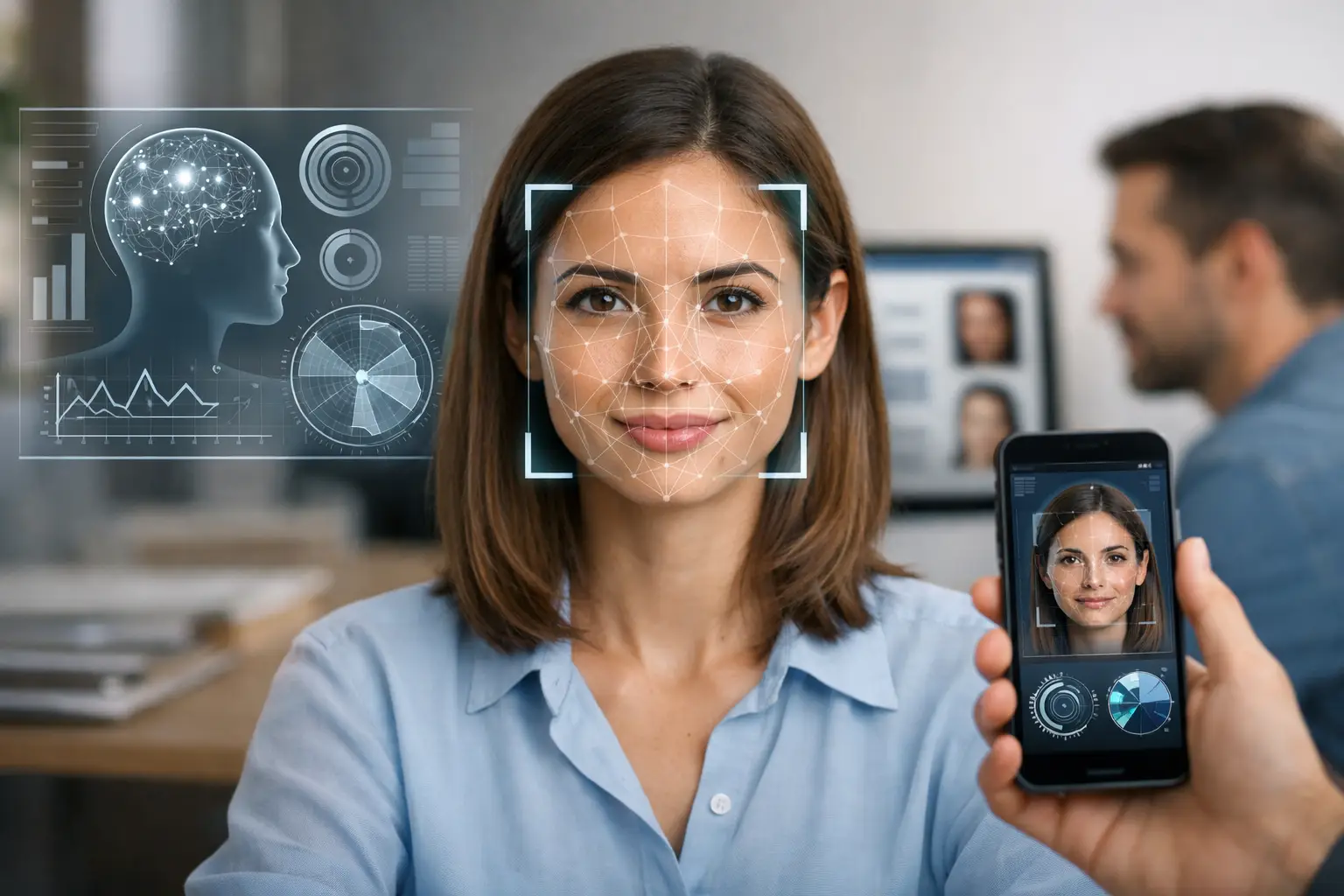
Most personality tools ask for 10 minutes of questions and give you a neat label. A review of an AI face analysis app for personality starts somewhere else - with a photo, a claim, and a harder question: can a scan of your face produce useful signals about character, emotional patterns, and fit?
That question matters because the appeal is obvious. If you're hiring, coaching, dating, or simply trying to read people faster, a guided scan feels far more efficient than long assessments or gut instinct. The best platforms know this. They don't just sell curiosity. They sell speed, structure, and a report that looks decisive enough to share.
What an AI face analysis app for personality is really selling
On the surface, these apps promise personality insight from facial input. Underneath, they are selling interpretation systems. The photo is the trigger, but the product is the framework wrapped around it - trait language, emotional patterning, compatibility signals, and professional-looking output.
That distinction is important. Users are rarely buying pure science. They are buying a readable model of a person. When an app presents findings through named systems like Pattern Analysis v4.2, Structural Integrity, Five-Element Mapping, or a 100-Year Life Map, it creates a sense of method and repeatability. For many buyers, that matters as much as technical accuracy because it turns a vague impression into something organized and actionable.
For professionals, this has obvious appeal. A manager wants fast clues about collaboration style. A recruiter wants another lens on candidate fit. A coach wants a conversation starter that feels sharper than generic advice. Consumers want the same thing for relationships, confidence, and career direction. The category works because it compresses uncertainty into a clean narrative.
Review: AI face analysis app for personality - what works
The strongest part of this kind of app is the experience design. A guided workflow lowers friction. You enter a name, anchor the subject, move through profile or image discovery, and receive a polished report without much effort. That ease matters because most users do not want a psychometrics lecture. They want a result.
A good platform also understands presentation. The output has to feel premium, not gimmicky. PDF-ready formatting, scored dimensions, labeled behavioral tendencies, and compatibility or career sections all increase perceived value. If the report reads like a professional breakdown rather than a novelty toy, users are more likely to trust it, save it, and share it.
There is also real practical value in structured language. Even when you treat the output as directional rather than absolute, a report can help people articulate what they already sense but cannot name. Someone who seems calm under pressure, guarded in conflict, or highly approval-sensitive becomes easier to discuss when those tendencies are presented in a systemized way. That alone makes the tool useful in meetings, coaching sessions, and personal reflection.
The best apps are especially good at confidence. Not false confidence for its own sake, but product confidence. Clear claims, visible process stages, method labels, and a strong report architecture all create momentum. Users are more likely to complete a scan when the system feels like an engine, not a toy.
Where the category overreaches
This is where a serious review has to get more precise. An AI face analysis app for personality can be useful without being literal truth in every line. That trade-off sits at the center of the product.
Facial analysis can generate patterns, but personality is not a fixed object sitting on the surface of the face waiting to be extracted. Expression, image quality, angle, lighting, age, grooming, and cultural bias all influence what the system sees. If the app speaks with total certainty about deep motives or long-range destiny from one image, that is a signal to slow down.
There is also a difference between compelling interpretation and validated assessment. Many users do not care much about that difference when the output feels accurate enough. But professionals should. If you're using the report for hiring, promotions, or serious compatibility decisions, it should support judgment, not replace it.
The most credible use case is not final decision-making. It is structured first-pass insight. Think of it as decision support, not decision authority. That framing keeps the tool useful while avoiding the biggest mistake in this category - confusing a persuasive report with a complete human evaluation.
What separates a strong platform from a weak one
Not every app in this space deserves attention. The weak ones feel generic within seconds. Their reports rely on broad statements, minimal visual structure, and recycled trait language that could apply to almost anyone. They read like automated horoscope copy dressed up as AI.
The stronger platforms create a clear sense of system depth. They guide the user through discovery, apply named analytical layers, and produce outputs that feel internally organized. That doesn't automatically make them more accurate, but it does make them more usable. In a crowded market, usability wins.
A stronger platform will usually show four things. First, a fast and intuitive scan flow. Second, a report with enough specificity to feel personalized. Third, a consistent methodology language that signals rigor. Fourth, a polished end product that holds up in personal or professional settings.
This is where a platform like SomaScan.ai fits naturally into the conversation. Its advantage is not just that it analyzes a face. Its advantage is that it productizes the analysis into a guided experience and a professional-grade report with a proprietary feel. That difference matters because buyers in this category are not shopping for raw AI. They are shopping for confidence, clarity, and presentable output.
Who should use one - and who should not
If you are naturally skeptical but open-minded, you are probably the ideal user. The tool works best when you want fast signals, conversation starters, or a structured second opinion. Coaches, managers, recruiters, and team leads can get value from the report language because it helps frame discussions around style, motivation, and interpersonal friction.
It is also a fit for consumers who enjoy self-discovery but want something more visually persuasive than a quiz. A face-based report feels immediate. It creates intrigue fast. That makes it easier to engage with than many traditional assessments.
But if you need scientific certainty, this category will frustrate you. And if you are tempted to use a face scan as a final verdict on whether someone is trustworthy, promotable, or relationship-ready, that is the wrong use. These tools can sharpen perception. They should not replace context, interviews, reference checks, or lived interaction.
How to evaluate an app before you trust the report
Start with the workflow. If the app feels rushed, vague, or visually cheap, the report usually follows the same pattern. A serious platform invests in the scan experience because that is where credibility begins.
Then look at the report itself. Is it specific without sounding random? Does it organize traits into meaningful sections such as emotional patterns, social tendencies, compatibility, or career alignment? Does it use a clear method language throughout, or does it jump between buzzwords?
Finally, judge the output by usefulness, not mystique. The right question is not, Is every sentence objectively provable? The better question is, Does this report help me see behavior more clearly, ask better questions, or make more grounded decisions? If yes, the tool has value.
The real verdict on AI face reading apps
The smartest way to review AI face analysis apps for personality is to avoid both extremes. They are neither magic mind readers nor worthless gimmicks by default. Their value depends on how well the platform structures the experience, how credible the report feels, and how responsibly the user applies the result.
At their best, these apps turn instinct into language. They package fuzzy impressions into a system people can actually use. That is why the category keeps growing. People do not just want data. They want readable judgment delivered fast.
If you approach the scan as a tool for insight rather than a machine for absolute truth, you will get far more from it. And if the platform delivers a clear method, decisive output, and a report worth revisiting, that is usually the difference between a novelty and a product people come back to.