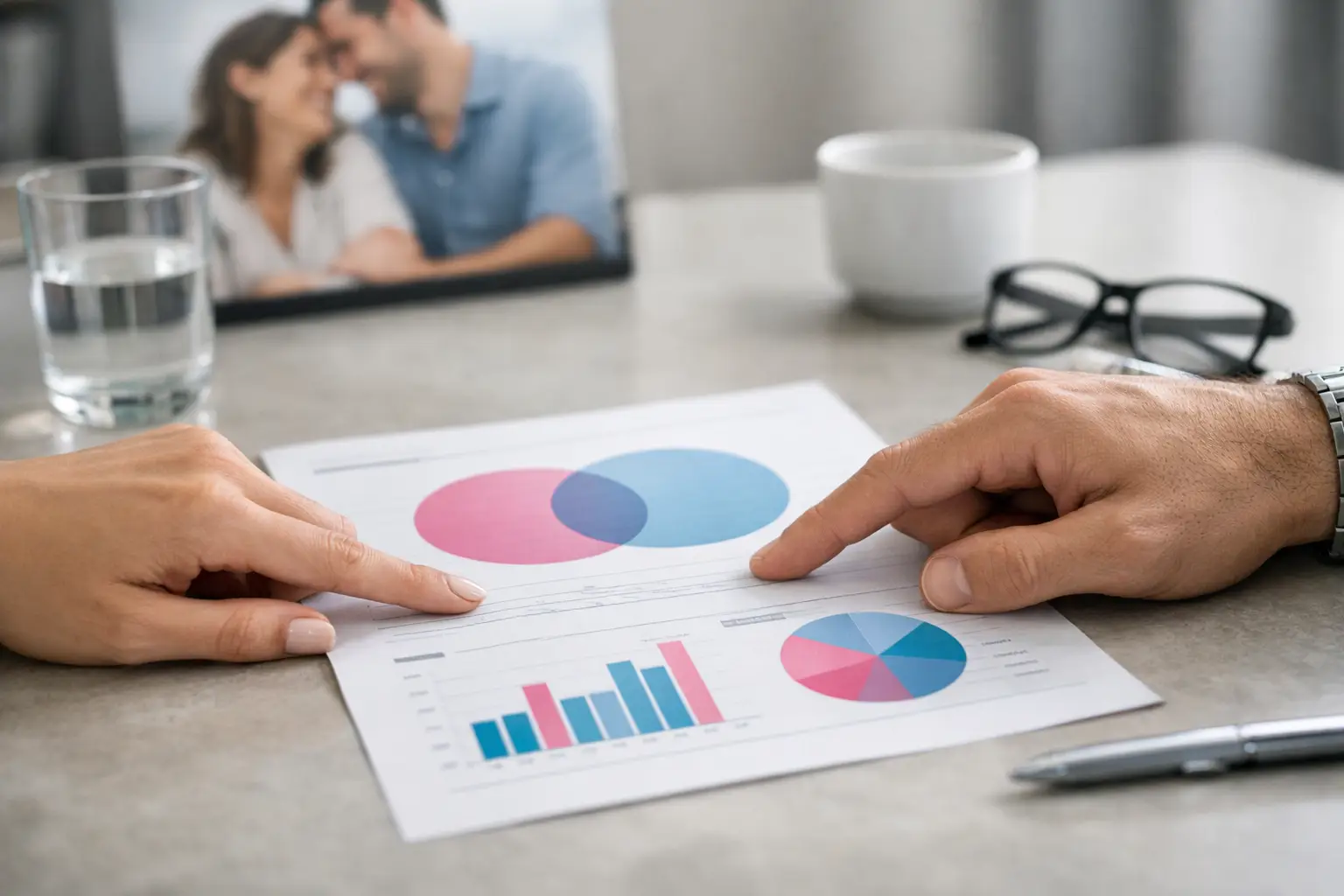
Most relationship problems do not start with the big blowup. They start three minutes earlier - in the tightened jaw, the withdrawn gaze, the half-second hesitation before a defensive answer. People miss those signals every day. That is where AI face reading for relationship communication gets interesting. Not as a magic verdict on love, but as a fast, structured way to surface the emotional patterns and personality tendencies that shape how two people talk, react, and misread each other.
For couples, dating partners, coaches, and even professionals trying to assess interpersonal fit, communication is rarely blocked by lack of words alone. It is usually blocked by pattern blindness. One person thinks they are being direct. The other experiences pressure. One believes they are staying calm. The other reads emotional distance. When those mismatches repeat, the relationship begins to run on assumptions instead of clarity.
What AI face reading for relationship communication actually does
At its best, AI face reading for relationship communication gives you a cleaner starting point. It analyzes facial structure and visual cues to generate a personality-oriented report about emotional tendencies, communication style, likely stress responses, and compatibility dynamics. The value is not in replacing human judgment. The value is in accelerating it.
That matters because most people are poor at reading themselves in real time. They know the fight happened. They do not always know the pattern that produced it. A strong face reading engine turns vague impressions into a more usable framework. Instead of saying, "We keep clashing for no reason," you get closer to, "One of us defaults to control under pressure, while the other withdraws when conversations feel too intense." That is a better conversation.
This is especially useful for people who want fast insight without formal assessments, long intake forms, or weeks of observation. A guided scan workflow can produce a report that feels immediate, structured, and shareable. For many users, that is the difference between curiosity and action.
Why communication breaks down even when both people care
Most communication advice is too general. Listen better. Use "I" statements. Stay calm. Fine advice, but weak diagnostics. It does not explain why two well-meaning people can still repeat the same argument in slightly different costumes.
The real issue is often style mismatch. Some people process emotion outwardly. Others process internally. Some need directness to feel secure. Others need softness before they can hear anything difficult. Some treat disagreement as a path to resolution. Others experience it as destabilization.
An AI-generated face reading report can help identify those tendencies early. Not with mystical certainty, but with enough structure to change the quality of the conversation. If a report points to a strong independence pattern, guarded emotional pacing, or high sensitivity to control dynamics, that gives both people language for what keeps happening.
That kind of language reduces lazy labeling. "You are cold" becomes "You take longer to trust." "You are too intense" becomes "You escalate quickly when you feel unheard." Those are not the same statement. One attacks identity. The other reveals a mechanism.
Where AI face reading helps most in relationships
The strongest use case is not mind reading. It is expectation management.
Early in dating, people often confuse chemistry with compatibility. Strong attraction can hide communication friction for weeks or months. Face reading adds another layer. It can flag whether one person is likely to lead with logic while the other leads with emotion, whether one seeks control and pace while the other needs spontaneity and reassurance, or whether both are prone to stubbornness under stress.
In established relationships, the benefit shifts. Here the goal is not deciding whether to continue. It is understanding why the same triggers keep resurfacing. A report can give couples a third reference point outside the usual blame loop. That matters because many arguments are not really about the stated topic. They are about timing, tone, pressure, fear, status, or unmet emotional pacing.
For coaches, therapists, recruiters, and team leads, the same principle applies. Relationship communication is not limited to romance. Every high-stakes interaction depends on reading temperament correctly. If you misunderstand how someone receives feedback, handles tension, or reacts to ambiguity, communication gets expensive fast.
The trade-off: insight tool, not final truth
This is where serious users separate signal from hype. AI face reading can be powerful, but it should be used as a decision-support system, not a final judgment on someone’s character or future.
Facial analysis can surface patterns. It cannot capture full context, life history, cultural norms, current stress load, or the quality of a relationship at this exact moment. Two people may show strong compatibility markers and still fail because timing is wrong. Two people may show communication friction and still build something excellent because both are self-aware and willing to adjust.
So yes, use the report. Study the tendencies. But keep the right frame. The point is not to let a machine tell you whom to love or trust. The point is to get a sharper map of likely strengths, blind spots, and pressure responses so your conversations start from reality instead of fantasy.
How to use an AI face reading report without overusing it
The best way to use relationship insight is to turn it into better questions.
If a report suggests emotional reserve, ask how that person prefers to open up when stressed. If it points to high dominance or strong will, ask what respectful disagreement looks like to them. If it identifies sensitivity, ask what kind of phrasing helps difficult conversations land without creating shutdown.
This moves the report from prediction to communication design. That is the practical win.
It also helps to compare the report against lived behavior. Does the person become more direct when anxious? Do they pull away when they feel judged? Do they seek reassurance or resist it? A good report should sharpen your observation, not replace it.
For people who want a polished system rather than a generic personality quiz, platforms like SomaScan.ai frame this process with a more structured methodology. That includes guided identity anchoring, profile discovery, and a professional-grade report built around personality architecture rather than surface-level traits. For users who value speed and a PDF-ready output, that format makes the insight easier to use in real conversations.
Signs the insight is helping
You know AI face reading for relationship communication is working when the conversation becomes less reactive and more precise. Not easier all the time - just more accurate.
You stop arguing about tone when the real issue is fear of rejection. You stop calling someone stubborn when the actual pattern is control under uncertainty. You stop assuming distance means lack of care when it may mean delayed emotional processing.
That shift matters because clarity changes behavior. When people feel seen correctly, they defend less and explain more. When they understand the other person’s response style, they can choose timing, wording, and pace more intelligently.
There is also a confidence advantage. Many people know a relationship dynamic feels off but cannot articulate why. A structured report gives them language. And language is leverage. Once a pattern has a name, it becomes easier to work with.
Common mistakes people make with face reading and communication
The first mistake is treating the output as destiny. A report may show likely tendencies, but tendencies are not sentences. Mature people can override weak habits and strengthen good ones.
The second mistake is using the insight as a weapon. If you pull someone’s report into an argument to prove they are the problem, you have already lost the value. The tool is for interpretation, not ammunition.
The third mistake is ignoring your own pattern while analyzing someone else’s. Relationship communication improves fastest when both sides are readable, not when one side becomes the observer and the other becomes the subject.
That is why the strongest results usually come when both people are approached with the same standard: what are the likely strengths, where are the pressure points, and how should communication adjust when tension rises?
Is it worth using for relationship decisions?
If you want perfect certainty, no. Nothing will give you that.
If you want faster clarity, better language, and a more structured view of compatibility and conflict style, yes. That is where AI face reading earns attention. It helps people move past vague chemistry, vague frustration, and vague assumptions. It gives shape to what is often felt but not named.
That makes it useful before a relationship gets serious, during communication repair, and in any setting where interpersonal fit matters. The biggest advantage is not prediction. It is pattern recognition at speed.
And in relationships, speed matters less than accuracy - but accuracy early can save months of confusion.
If a tool helps you ask better questions, notice emotional timing, and speak to the person in front of you instead of the story in your head, that is not a gimmick. That is better communication with better inputs.