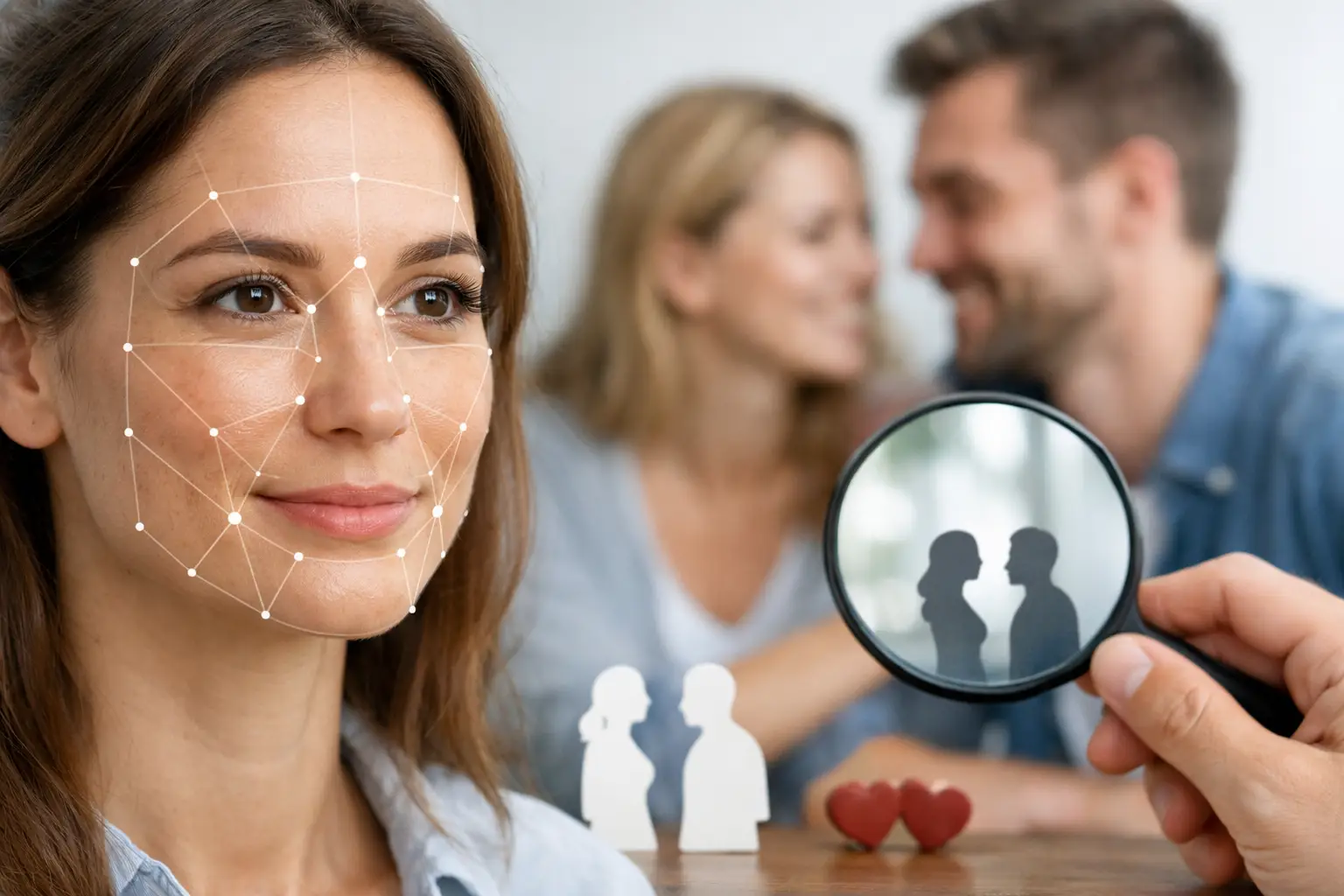
Most relationship advice starts after the damage is done. Face reading is useful earlier - at the moment you are trying to figure out whether someone feels safe, steady, guarded, intense, avoidant, or simply hard to read.
That is why a real guide to face reading for relationships matters. Not because a face can predict your entire future with someone, and not because one photo can replace conversation. It matters because facial structure and expression patterns can surface tendencies that people often miss when chemistry, stress, or wishful thinking gets in the way.
Used well, face reading is not a magic trick. It is a decision-support tool. It helps you spot emotional style, pressure points, and compatibility signals faster.
What face reading can actually tell you in relationships
A face does not hand you a perfect verdict on loyalty, long-term commitment, or whether a person will text back. What it can do is reveal patterns in how someone tends to process emotion, manage pressure, express warmth, and hold boundaries.
That makes it especially useful in early dating, in established partnerships, and in high-stakes people decisions where personal dynamics matter. Recruiters and managers already look for presence, confidence, and emotional composure. Relationship-minded readers are doing something similar, just with more personal stakes.
The strongest relationship signals usually come from pattern clusters, not one isolated feature. A broad forehead by itself is not a compatibility answer. A tense mouth by itself is not a red flag. But when forehead structure, eye shape, brow tension, jaw definition, and resting expression all point in the same direction, a clearer picture starts to form.
This is where disciplined analysis beats guesswork. You are not asking, "What does one feature mean?" You are asking, "What personality architecture keeps repeating across the face?"
A practical guide to face reading for relationships
If you want useful results, read the face in layers. Start with structure, then expression, then consistency.
Layer 1: Read the overall structure
The first layer is the face as a whole. Is it balanced or sharply asymmetrical? Soft or angular? Open or compact? Broadly speaking, softer and more rounded features often suggest receptivity, emotional availability, and a more relational orientation. More angular or tightly held facial structure can suggest discipline, control, protectiveness, or a stronger need for autonomy.
Neither profile is better. It depends on what kind of relationship you are building. A highly independent face pattern may work extremely well with someone who values space and directness. The same pattern may feel emotionally distant to a partner who needs frequent reassurance.
Jaw and chin structure often speak to resolve and will. Stronger lower-face definition can correlate with persistence, stubbornness, and follow-through. That can be attractive and stabilizing. It can also create power struggles if both people are highly fixed in their approach.
Layer 2: Read the eyes and brow zone
In relationship face reading, the eye area matters more than most people think. Eyes often carry the clearest signals around attention, emotional openness, guardedness, and internal intensity.
A more open, relaxed eye area may suggest warmth and easier emotional access. Narrower or more guarded eyes can indicate caution, skepticism, or a habit of filtering what gets expressed. Again, context matters. Guarded does not mean deceptive. It can simply mean private.
Brows add another layer. Strong, defined brows can signal force of personality, conviction, and assertiveness. More relaxed brow lines can suggest adaptability or an easier emotional tone. If the brow area shows chronic tension, that may point to overthinking, vigilance, or stress-loading under pressure.
For relationships, this distinction matters. Some people are expressive in calm moments but shut down under stress. Others look intense by default but stay remarkably consistent when conflict hits. Face reading gets more useful when you compare baseline expression with pressure expression.
Layer 3: Read the mouth and emotional style
The mouth is one of the fastest indicators of emotional containment versus emotional disclosure. A relaxed, naturally expressive mouth can suggest openness and a lower barrier to communication. A tighter resting mouth may suggest restraint, self-protection, or a tendency to process internally before speaking.
This is often where attraction gets misread. People regularly interpret restraint as mystery, when in practice it may signal emotional inaccessibility or high caution. On the other side, a highly expressive mouth may feel inviting, but without structural steadiness elsewhere in the face, it can also point to volatility or inconsistency.
The useful question is not, "Do they seem warm?" It is, "How do warmth, control, and pressure management show up together?"
What compatibility looks like in face reading
Compatibility is not about finding a mirror image. It is about finding patterns that either support each other or create predictable friction.
Two highly intense faces can create exceptional chemistry. They can also create conflict escalation, especially if both show strong lower-face control and brow tension. Two softer, more receptive patterns may build emotional ease, but they may struggle with decisiveness or conflict resolution. A grounded, structured face paired with a more emotionally expressive face can be an excellent complement - if both people respect the difference.
This is why face reading for relationships works best as a comparative method. You are not just reading one person. You are reading how two pattern systems may interact.
A few useful pairings tend to stand out. Strong structure plus strong warmth often signals partnership stability. High intensity plus low openness can feel magnetic at first but become hard to sustain. Emotional softness plus emotional softness can feel easy and supportive, but only if someone in the pair can still handle pressure cleanly.
Chemistry is immediate. Compatibility is structural.
Where people get face reading wrong
The biggest mistake is turning one feature into a verdict. The second biggest mistake is using face reading to confirm what you already want to believe.
If you are highly attracted to someone, you may interpret intensity as depth, distance as mystery, or control as maturity. If you are anxious, you may interpret composure as coldness. Good analysis corrects for projection.
Another common mistake is ignoring expression drift. A carefully posed image can hide a lot. Relationship insight gets sharper when you compare multiple images, natural lighting, profile angles, and unguarded resting expressions. Consistency matters. If one image looks open and five others look tightly controlled, trust the repeated pattern.
This is also why automated systems can help. A platform like SomaScan.ai is built to reduce human projection by using a guided scan workflow, profile and image discovery, and structured pattern reporting rather than gut instinct alone. That kind of process is useful when you want clearer signals without pretending your first impression is always correct.
How to use face reading without becoming cynical
The point is not to judge people faster. The point is to understand them sooner.
Face reading works best when it shapes better questions. If a face suggests guardedness, do not label the person closed-off and move on. Ask whether they open slowly or stay private even in trust. If the structure suggests high intensity, pay attention to how they handle frustration, delays, and disagreement. If warmth is visible, test whether it stays present when boundaries are needed.
In other words, read patterns, then verify them in real life.
That approach protects you from two bad outcomes. First, idealizing someone based on attraction. Second, dismissing someone whose face is simply more reserved than your preference. Some of the most stable long-term partners look harder to read at first. Some of the most charming early connections do not hold up under pressure.
FAQ: face reading for relationships
Can face reading predict whether a relationship will last?
Not by itself. It can identify emotional style, conflict patterns, and compatibility pressure points. Longevity still depends on choices, communication, timing, and maturity.
Is face reading better than personality tests for dating?
It depends on the situation. Personality tests rely on self-report. Face reading looks at visible pattern signals that people may not describe accurately about themselves. Used together, they are stronger.
Should you read a single selfie or multiple images?
Multiple images are better. One selfie can be curated. Repeated patterns across angles and expressions are far more reliable.
What is the best way to start?
Start broad. Read overall structure, then the eye area, then the mouth and jaw. Look for repeated themes instead of chasing one dramatic feature.
Relationships usually break down around the things people failed to see early. Face reading gives you a sharper first pass - not to replace trust, but to build it with better judgment.