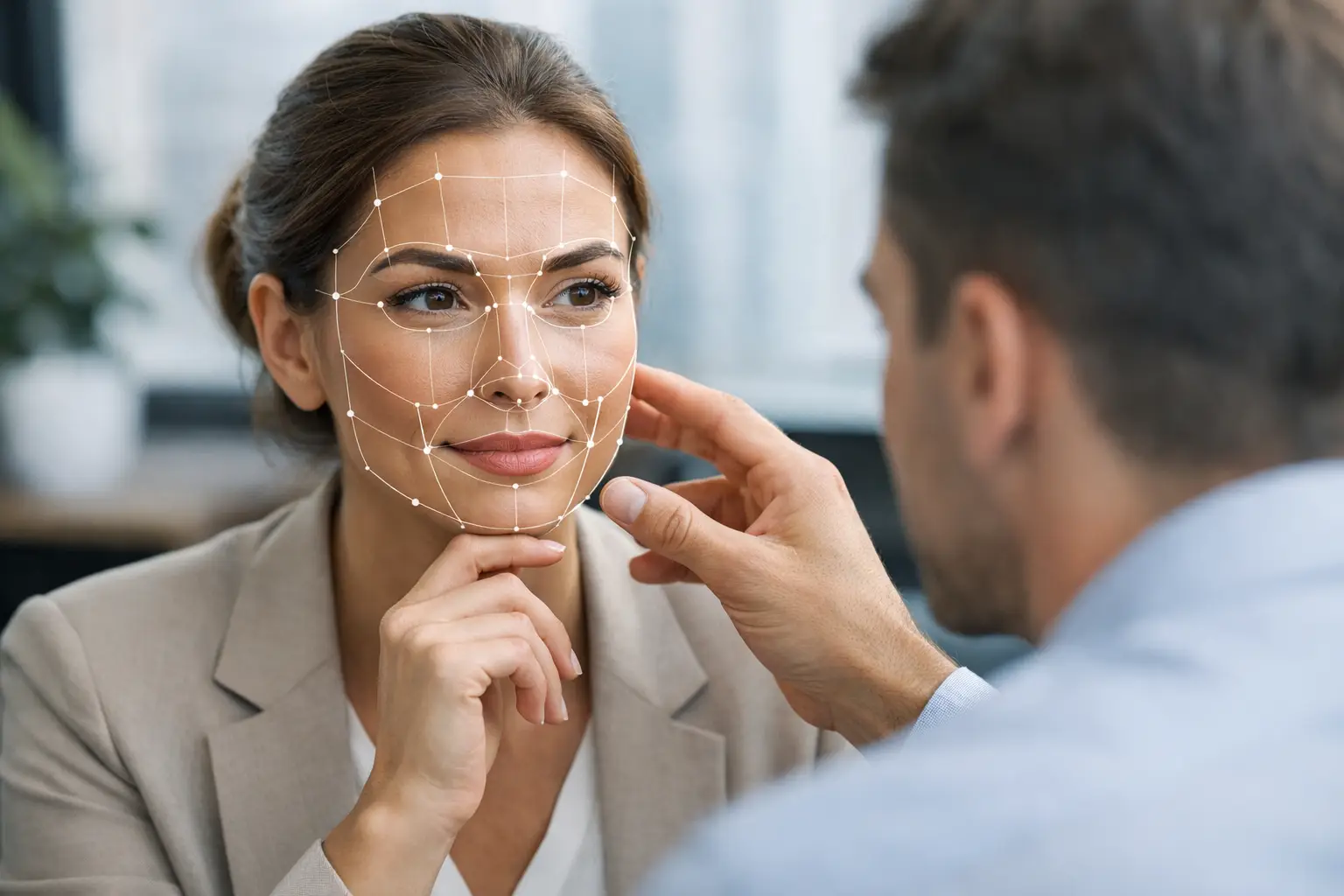
You can learn a lot about a person in the first thirty seconds - but most people still second-guess what they saw. Was that confidence or defensiveness? Warmth or performance? Face reading exists because people want faster signal, less guesswork, and a clearer read on character before the conversation gets complicated.
For professionals, that matters. Hiring managers want better instinct around fit. Coaches want cleaner emotional context. Team leads want to understand friction before it shows up in meetings. Individuals want answers about compatibility, trust, communication style, and career direction. Face reading offers a structured way to turn visual cues into usable insight.
What face reading actually means
Face reading is the practice of interpreting facial structure, proportions, tension patterns, and visible expression tendencies to infer personality traits and behavioral patterns. At its best, it is not fortune telling and it is not random guessing. It is pattern analysis.
The logic is simple. Faces carry stable architecture and dynamic signals at the same time. Bone structure, feature spacing, symmetry, jaw definition, forehead shape, eye set, and mouth tension can all be treated as inputs. Those inputs are then mapped against a framework that looks for recurring trait clusters such as decisiveness, restraint, sociability, emotional intensity, persistence, and adaptability.
That is why face reading has stayed relevant. People are not just looking for labels. They want a faster model for understanding how someone tends to process pressure, handle relationships, assert themselves, or respond to uncertainty.
Why face reading feels useful so quickly
Most personality tools ask for time, self-reporting, and cooperation. Face reading works differently. The face is already there. That makes it fast, low-friction, and appealing for people who need immediate directional insight.
This is especially useful when the goal is not clinical diagnosis or absolute truth, but a stronger first-pass read. In work settings, that can help frame communication style and collaboration expectations. In personal settings, it can give language to patterns people already sense but cannot articulate.
The real advantage is speed paired with structure. A strong system does not just say someone looks confident or intense. It breaks that impression into components. Is the person action-led or reflective? More guarded or more transparent? Built for consistency or novelty? Once those patterns are named, the insight becomes easier to apply.
How face reading works in a modern system
Traditional face reading depended heavily on the reader. That created a credibility problem. One practitioner might see leadership where another sees dominance. A modern AI-driven approach improves consistency by turning subjective impressions into repeatable analysis layers.
A platform like SomaScan.ai approaches face reading as an engine, not a guess. The workflow begins with identity anchoring, then moves through profile and image discovery, then applies a structured analysis model to produce a polished report. That matters because users do not just want an opinion. They want a system.
The facial inputs that matter most
Not every detail carries the same weight. In most high-quality face reading frameworks, the strongest signals come from structural relationships rather than one isolated feature. A broad forehead may suggest one set of tendencies, but its meaning shifts depending on the jawline, eye spacing, cheek structure, and overall balance of the face.
This is where proprietary method language starts to matter. Terms like Structural Integrity, Five-Element Mapping, and Pattern Analysis v4.2 do more than sound advanced. They signal that the reading is based on multiple layers instead of a single visual cue. For users, that creates a more credible path from image to insight.
What a report can reveal
A useful face reading report should move beyond vague personality adjectives. The strongest reports identify behavioral tendencies people can use right away. That includes emotional pacing, communication posture, conflict style, social energy, ambition signals, relationship orientation, and career alignment patterns.
For example, someone may present a facial pattern associated with strong internal control, low emotional leakage, and high decision firmness. In one environment, that can read as executive calm. In another, it can create distance or rigidity. Good analysis does not pretend one trait is universally positive. It shows where the advantage is and where friction may appear.
That trade-off is what separates entertainment from applied insight.
What face reading can tell you - and what it cannot
This is where credibility matters most. Face reading can be powerful, but only when expectations are set correctly.
It can help identify personality tendencies, likely behavioral defaults, emotional patterns, and interpersonal style. It can support better framing in hiring, coaching, team building, dating, and self-reflection. It can give people a language for strengths that feel natural and blind spots that keep repeating.
What it cannot do is replace full context. A face does not reveal every life event, every value, every skill, or every decision a person will make next year. Environment matters. Culture matters. Maturity matters. A strong-willed face on a 22-year-old may play very differently on a seasoned executive who has learned restraint.
The smart position is not to treat face reading as absolute. It is to treat it as a high-speed intelligence layer. In the same way a resume does not tell the whole story but still matters, a facial analysis report is best used as a structured signal, not a final verdict.
Why AI face reading is gaining traction
The demand is easy to understand. People want insight fast. They want something easier than formal assessments and more structured than intuition. AI face reading meets that demand because it turns a simple input into a finished, shareable output.
That output matters more than most people realize. A clean, PDF-ready report changes the experience from novelty to utility. It gives managers something to discuss, coaches something to frame, and individuals something to revisit. It feels less like a party trick and more like a professional-grade reading.
There is also a convenience advantage. Most users do not want to study morphology, compare feature maps, or learn legacy interpretation systems. They want a guided scan, a clear result, and language they can use immediately. That is why automated face reading products are moving from curiosity purchases into recurring use across personal and professional settings.
Where face reading is most practical
In hiring and team settings, face reading can act as an early lens on working style. It may help highlight who is naturally assertive, who processes slowly but deeply, who is likely to push conflict directly, and who avoids friction until it builds. That should never replace interviews or performance data, but it can improve the questions people ask.
In relationships, the value is different. Here, face reading often helps users understand emotional expression, attachment style, intensity, and compatibility dynamics. People are often less interested in whether a match is perfect and more interested in where misunderstanding is likely to start.
For personal growth, the appeal is even simpler. Many people want confirmation around what drives them. They want to know why they keep choosing certain environments, why they are energized by some people and drained by others, and where their strongest tendencies become liabilities. A strong reading gives shape to those questions.
The best way to use a face reading result
Use it as a decision support tool, not a script. If a report flags dominance, emotional reserve, or a high-control pattern, treat that as a lens for observation. See whether it shows up in conversation, conflict, leadership, or relationships. The goal is not blind belief. The goal is better pattern recognition.
It also helps to focus on repeated traits rather than dramatic claims. A report is most valuable when it points to tendencies that affect daily life - how someone handles pressure, how fast they trust, how they express disagreement, how they pursue goals. Those are the patterns that actually shape outcomes.
And if you are using AI face reading professionally, context is everything. Pair the analysis with interviews, references, and lived interaction. The strongest judgment comes from combining fast signal with real-world evidence.
Is face reading accurate?
That depends on the method, the input quality, and how accuracy is defined. If accuracy means predicting every detail of a person’s life, no. If accuracy means identifying strong personality architecture, communication tendencies, and recurring emotional patterns from facial data, the answer can be surprisingly strong when the system is structured well.
The difference is rigor. Generic readings tend to feel flattering but vague. High-quality systems feel specific. They identify strengths, tensions, and contradictions in a way that users recognize immediately. That recognition is often the clearest sign that the model is tracking something real.
People do not return to face reading because they want fantasy. They return because a precise reading can compress weeks of observation into a few minutes of clarity. When that clarity is delivered through a guided workflow and a confident report, it becomes more than entertainment.
The smartest use of face reading is simple: let it sharpen your read on people, including yourself, then test what you learn in real life.