You do not have time to run a 90-minute interview just to learn that someone avoids conflict, hates ambiguity, and needs clear ownership. You need a fast read you can actually use - in hiring, team dynamics, coaching, or relationships.
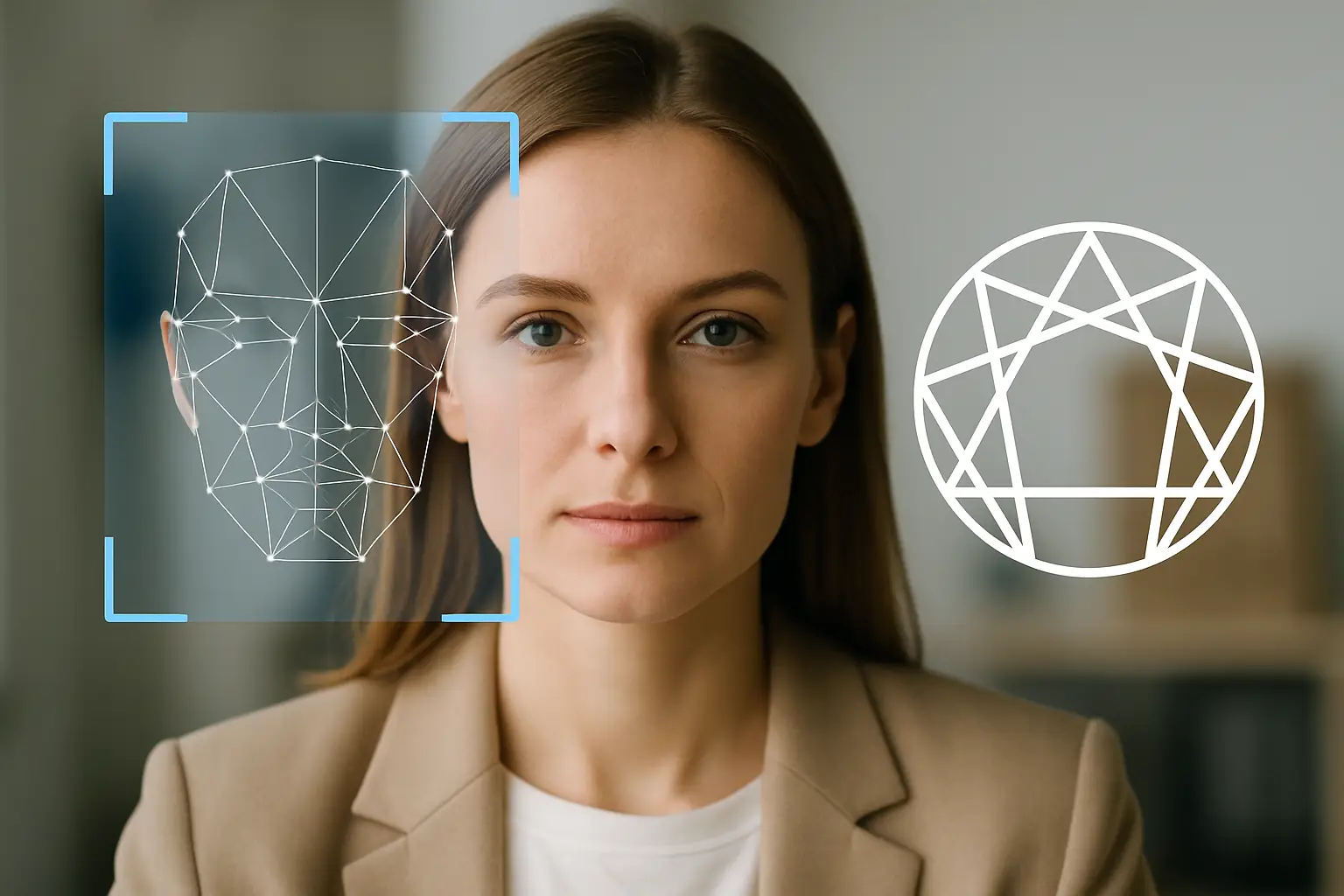
That is where two very different tools show up: AI face reading and the Enneagram test. They both promise “personality clarity,” but they get there in opposite ways. One starts with observable signals. The other starts with self-report.
If you are deciding between them, the right question is not “Which one is more accurate?” The right question is “Which one is more useful for the decision I am making, with the time and honesty I can reasonably expect?”
AI face reading vs enneagram test: what you are really choosing
At a high level, this is a trade between speed and introspection.
AI face reading is built for rapid signal extraction. You provide a face input, the system runs pattern detection, and you get a structured readout that tries to map outward features to inward tendencies. It is designed for moments when you need an immediate lens - a first-pass personality architecture, a compatibility snapshot, a tension forecast.
An Enneagram test is built for reflective self-identification. You answer prompts about fears, desires, and behavioral defaults, then receive a type model that frames motivation. It works best when the person taking it is self-aware, honest, and willing to engage the result instead of using it as a costume.
Both can be useful. Both can mislead you. The difference is how they fail.
How AI face reading works (and why people use it)
AI face reading takes what humans already do in the first five seconds and tries to systematize it. Humans scan faces for stability, warmth, intensity, openness, dominance, stress load - then we make a call. Most of the time we cannot explain that call, and our biases leak in.
A productized AI approach claims it can reduce the “vibes” problem by enforcing a consistent framework: the same inputs, the same methodology, the same report structure. Instead of an unspoken impression, you get a written profile with named dimensions you can discuss.
The practical appeal is obvious for professionals.
In recruiting and management, you want fast signals about communication style, pressure response, emotional range, and interpersonal friction points. In relationships, you want early warning signs about conflict patterns and attachment tendencies. In coaching, you want a starting architecture so you can move straight to interventions.
The catch: AI face reading is a high-velocity inference system. The output can feel definitive even when it should be treated as directional. The more you use it like a hypothesis generator - not a final verdict - the more value you get.
How the Enneagram test works (and why it persists)
The Enneagram is not primarily about behavior. It is about motivation. That is why it has staying power.
A good Enneagram experience forces people to confront why they do what they do: what they chase, what they avoid, and what they fear losing. It also gives teams a shared language for “This is how I get weird under stress” without turning it into a moral judgment.
But the Enneagram test is still a test. That means it inherits every weakness of self-report:
People answer how they want to be seen. People answer how they see themselves on a good day. People answer based on their current mood. People misunderstand the questions. People game it when incentives are on the line.
If you are using it in hiring, you are asking candidates to voluntarily expose their internal operating system in a context where the safest move is to look stable, adaptable, and low-maintenance. That is not a realistic expectation.
The core difference: external signals vs self-story
AI face reading is an outside-in model. It starts with physical cues and predicts tendencies.
The Enneagram is an inside-out model. It starts with self-perceived motivation and predicts patterns.
Outside-in tools can be useful when you do not have reliable access to someone’s self-story. Inside-out tools can be powerful when the person is willing to tell the truth and sit with it.
So the “better” method depends on the environment.
If you are trying to understand a direct report who is defensive and vague, self-report will be noisy. If you are trying to help a high-performing leader who is committed to growth, self-report can be unusually clean.
What each method is best at in real life
Hiring and recruiting
If you need a quick screen for communication friction and team-fit risk, AI face reading tends to be more usable early because it does not depend on the candidate volunteering unflattering truths. It gives you an initial profile you can probe with targeted interview questions.
The Enneagram can be helpful later, but only if you frame it correctly: as development language, not a pass-fail filter. When companies use personality typing as a gate, applicants will perform for the model.
Team dynamics and leadership
Enneagram shines when you have ongoing relationships and enough psychological safety for people to admit their default coping strategies. That is where “type language” becomes a shortcut to empathy.
AI face reading shines when you need a clean, professional artifact you can share quickly - a report that anchors a discussion without requiring everyone to buy into a specific spiritual or therapeutic tradition.
Dating and compatibility
In dating, the issue is not “Do we have different motivations?” The issue is “What happens under stress, jealousy, ambiguity, or silence?”
Enneagram can explain the motive underneath a conflict pattern. AI face reading can flag the pattern itself quickly, which is often what people want in the first place: a faster read on emotional intensity, stability, and interpersonal push-pull.
Coaching and self-development
If someone is already committed to introspection, the Enneagram gives a deep mirror. If someone wants clarity without months of journaling, AI face reading gives a starting map they can react to. Reaction matters - sometimes the most useful insight is not the report itself, but what the person instantly agrees with or rejects.
Where AI face reading can go wrong
The failure mode is over-certainty.
A face-based inference can look clean on a page and still be wrong for the individual. You can also misapply a result by treating it as destiny instead of tendency.
Use it like a structured first impression, not a psychological diagnosis. The best operators treat it as a decision-support layer: something that helps you ask sharper questions, notice patterns faster, and reduce blind spots.
Also, context matters. Lighting, angle, and image quality can distort signals. So can short-term factors like fatigue, stress, or recent weight changes. If you want a professional-grade output, you need a controlled input.
Where the Enneagram test can go wrong
The failure mode is identity cosplay.
People love types because types feel like certainty. But the Enneagram can become an excuse: “I am a Type X, so I do this.” That is not insight. That is branding.
The other failure is mistyping. Plenty of people pick the type they aspire to, not the one that actually runs them under pressure. If you are using it for team decisions, mistyping can create false confidence and misaligned expectations.
A smarter approach: use both, but in the right order
If you are trying to make a real-world decision quickly, start with the method that does not require cooperation.
AI face reading gives you an immediate architecture and likely friction points. Then you validate it with conversation, references, and situational questions. After there is trust, the Enneagram can deepen the model by revealing motivation and growth edges.
In other words, use AI to get to a sharper first draft. Use Enneagram to refine the draft when honesty is available.
This is also the most ethical way to use typology: no single tool gets to be the judge, jury, and sentencing.
What to look for in an AI face reading report
Not all face reading outputs are equal. The useful ones feel like systems, not fortune cookies.
A strong report will name specific dimensions, define what each dimension means behaviorally, and translate that into practical scenarios: communication, conflict, leadership under stress, and compatibility patterns. It should read like a professional profile you can discuss with a partner, a candidate, or a team lead without feeling like you are passing around a meme.
If you want an example of this productized, framework-first approach, SomaScan.ai positions itself as a #1 AI Face Reading Engine and delivers a PDF-ready report built around proprietary-sounding modules like Pattern Analysis v4.2, Structural Integrity, Five-Element Mapping, and a 100-Year Life Map. Whether you use that platform or another, the bar is the same: structured traits, clear language, and actionable interpretation.
The honest bottom line
AI face reading is built for speed, consistency, and professional packaging. The Enneagram test is built for depth, motivation, and long-term growth language. If you are making decisions under time pressure, AI tends to be the faster lever. If you are building self-awareness over months, Enneagram tends to be the deeper mirror.
The most effective users do not argue about which one is “real.” They use the right tool for the right moment, then verify with reality.
The helpful move now is simple: pick one real decision you have to make this week - a hire, a partnership, a first date, a team conflict - and choose the method that gives you usable signal within your actual constraints. Clarity is not a philosophy. It is leverage.