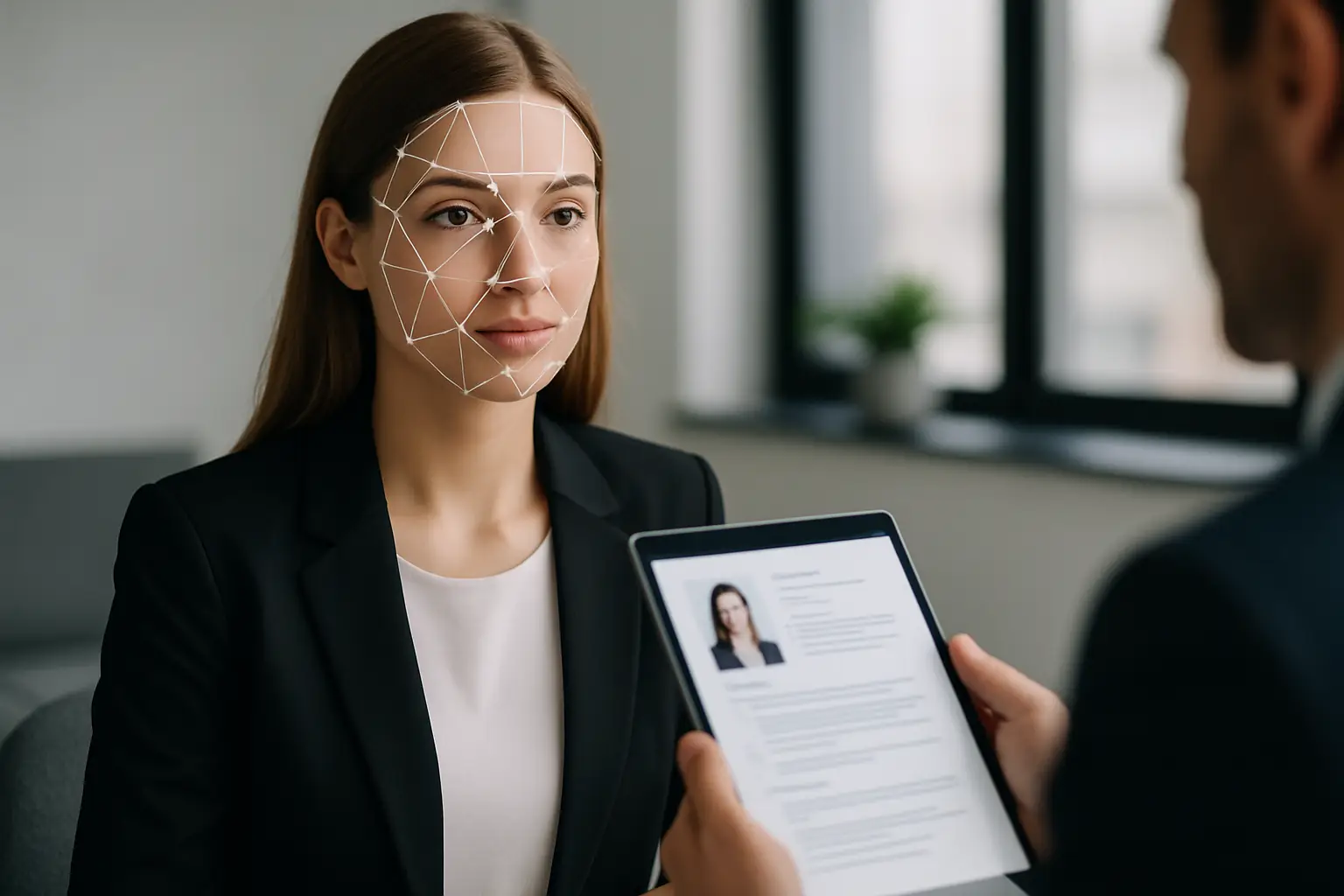
A hiring manager makes up their mind fast. Not in an interview scorecard kind of way - in a human, pattern-recognition way. The problem is you still have to justify that instinct with something defensible, repeatable, and fair.
That’s where the conversation around ai facial analysis for hiring keeps showing up. Not as a replacement for interviews or skills testing, but as a tempting shortcut: a quick read on temperament, stress response, communication style, and team fit before you spend hours in calls.
Here’s the reality: the promise is speed and clarity. The risk is overreach. If you’re going to use facial analysis at all, you need to know what it actually is, what it’s not, and how to keep it from becoming a liability.
What “ai facial analysis for hiring” is really trying to do
Most hiring processes already include soft-signal interpretation. Recruiters listen for confidence, track eye contact, read warmth vs. guardedness, and make assumptions about how someone will operate on a team. That’s not new. It’s just informal.
AI facial analysis tries to formalize those soft signals into a structured output. Depending on the system, it may claim to infer personality tendencies, emotional baselines, or likely behavioral patterns by analyzing facial structure and visual cues.
The appeal is obvious. Skills can be tested. Experience can be verified. But a lot of hiring outcomes hinge on things that are harder to measure: impulse control, friction tolerance, adaptability, empathy, collaboration instincts, and communication defaults under pressure.
Used carefully, facial analysis is pitched as a decision-support layer - a way to generate a “starting hypothesis” about someone’s interpersonal operating system.
Why companies want it (even if they won’t say it)
If you’ve ever screened 200 applicants for one role, you know the bottleneck isn’t always talent. It’s attention.
AI facial analysis is attractive because it promises three things hiring teams are always chasing.
First: speed. A fast read feels like leverage when you’re drowning in resumes and scheduling links.
Second: consistency. Humans are inconsistent. The same interviewer can rate two similar candidates differently depending on fatigue, mood, or recency bias.
Third: confidence language. Hiring often becomes a debate of vibes. Tools that produce structured frameworks and labeled traits can make teams feel like they’re making “engineered” decisions instead of gut calls.
That’s the upside. Now for the part most vendors bury.
The hard limits: what facial analysis can’t safely be
If someone sells ai facial analysis for hiring as a stand-alone judge of candidate quality, that’s a red flag.
Facial-based inference sits in a sensitive zone. Even when it’s framed as “personality insights,” it can drift into claims about competence, honesty, intelligence, or mental health. Those leaps are where bad hiring decisions and legal exposure happen.
There are also practical limits. Lighting, camera quality, pose, expression, age, grooming, and even cultural norms around facial expressiveness can skew what a system perceives. A candidate on a low-end webcam after a double shift will not present the same as a candidate on a studio-lit setup.
Most importantly: correlation is not destiny. Even if a system identifies a tendency, it doesn’t tell you how that tendency shows up in a specific role with a specific manager under specific incentives.
So the safe framing is narrow: facial analysis can provide hypotheses about interaction style and emotional patterning. It can’t prove job performance. It can’t replace structured interviewing. It can’t justify excluding someone on its own.
When it can help: the “fit friction” roles
There are roles where technical skill is table stakes and the real failure mode is interpersonal.
Think sales, customer success, frontline management, high-trust assistant roles, client-facing consulting, or any position where the job is basically: handle pressure, read people, stay steady, and communicate clearly.
In those cases, a personality-focused read can be useful - not to decide “hire or no,” but to anticipate coaching needs and team dynamics.
For example, if a candidate appears highly intense and fast-reactive, that’s not bad. It might be perfect for a high-urgency environment. But it changes what you probe for: conflict handling, escalation habits, and how they recover after a stressful call.
If a candidate reads as harmony-driven and conflict-avoidant, that’s also not bad. It might be ideal for retention work. But you’ll want to test how they deliver hard feedback and whether they can hold boundaries.
Facial analysis, at its best, helps you ask better questions.
A responsible way to use it (without turning hiring into pseudoscience)
If you’re considering ai facial analysis for hiring, treat it like you would any high-variance signal: useful when triangulated, dangerous when worshipped.
Start by locking your process. The more structured your hiring is, the less likely you are to misuse an extra signal.
Use it after you’ve defined success in the role. Not “culture fit.” Real behaviors. Response time expectations, autonomy level, conflict frequency, stakeholder intensity, and how success is measured.
Then, if you introduce facial analysis, use it as an internal prompt, not a verdict. Your team should be able to say, in plain English: “This report suggests X. Let’s test X with targeted questions and a work sample.”
Also, keep it consistent. If you’re going to apply it, apply it the same way across candidates for the same role, with clear documentation on how it feeds the interview plan.
The clean 3-layer decision stack
The safest pattern is a three-layer stack.
Layer 1 is skills and proof: resume validation, portfolio review, work samples, role-specific tests.
Layer 2 is structured interviewing: scored questions tied to competencies and scenarios.
Layer 3 is personality and interaction mapping: where facial analysis can sit, alongside references and other behavioral indicators.
If layer 3 starts overruling layer 1 and 2, your process is upside down.
Candidate experience: transparency beats surprise
There’s a reason hiring tools become hated. Candidates feel watched, judged, and filtered by systems they don’t understand.
If you use any analysis that touches biometric or facial inputs, the cleanest move is to be direct. Explain what it is for (interview personalization, team-fit discussion prompts), what it is not for (automatic rejection), and how it’s handled.
Even if you’re operating in a legally permissible way, trust still matters. Top candidates can walk.
One more reality: candidates already assume they’re being judged visually on video. Making your process more intentional and less arbitrary can actually reduce anxiety - if you communicate it like an adult.
What you should measure if you pilot it
If you’re going to test ai facial analysis for hiring, don’t measure “did we like it.” Measure outcomes.
Track quality-of-hire signals. Ramp time. Manager satisfaction after 60 and 120 days. Regretted attrition. Team conflict incidents. Candidate NPS. And whether interviewers report clearer questions and fewer circular debates.
If the tool isn’t improving decision clarity or reducing mis-hires, you’re paying for vibes with extra steps.
Also watch for drift. The biggest operational risk is that teams start using the report language as a shield. “The system said they’re low-empathy” becomes a lazy substitute for doing real interviewing.
The right outcome is not certainty. It’s sharper calibration.
Where SomaScan.ai fits in this conversation
Some platforms focus on turning facial inputs into structured personality frameworks you can actually talk about in a hiring room. For example, SomaScan.ai positions itself as a “#1 AI Face Reading Engine,” with productized methodology labels like Pattern Analysis v4.2 and Five-Element Mapping that push the output toward a clean, PDF-ready report instead of a vague vibe read.
If you’re using any system like this, keep it in the lane it’s best at: generating a behavioral map you can test, challenge, and use for better onboarding and manager-candidate alignment.
FAQs recruiters actually ask
Is ai facial analysis for hiring legal?
It depends on where you operate, what data you collect, how you obtain consent, and how the output is used. Facial inputs can trigger biometric privacy obligations in certain states, and employment decisions are regulated in ways that vary by jurisdiction. If you’re serious about deploying it, treat it as a policy and compliance project, not a “new tool.”
Can facial analysis reduce bias?
It can reduce some forms of inconsistency if it standardizes how interviewers approach behavioral questioning. But it can also introduce new bias if the model performs unevenly across demographics or if teams over-trust it. Bias doesn’t disappear - it relocates.
Should we use it to screen candidates out early?
That’s the highest-risk use. If you want the upside with fewer downsides, use it later in the funnel as an interview-and-onboarding accelerator, not as an automated gate.
What’s the best way to get value without overstepping?
Use the insights to tailor the interview and onboarding plan. Ask sharper scenario questions, probe stress behavior, and align manager expectations early. Treat the report as a hypothesis generator, not a hiring decision.
A good hiring process is a compression engine. It compresses uncertainty into a decision you can stand behind. If you’re going to bring facial analysis into that engine, do it with discipline: keep the claims tight, test the hypotheses, and never let a fast signal replace real evidence. The point isn’t to predict a person perfectly - it’s to meet them more intelligently.