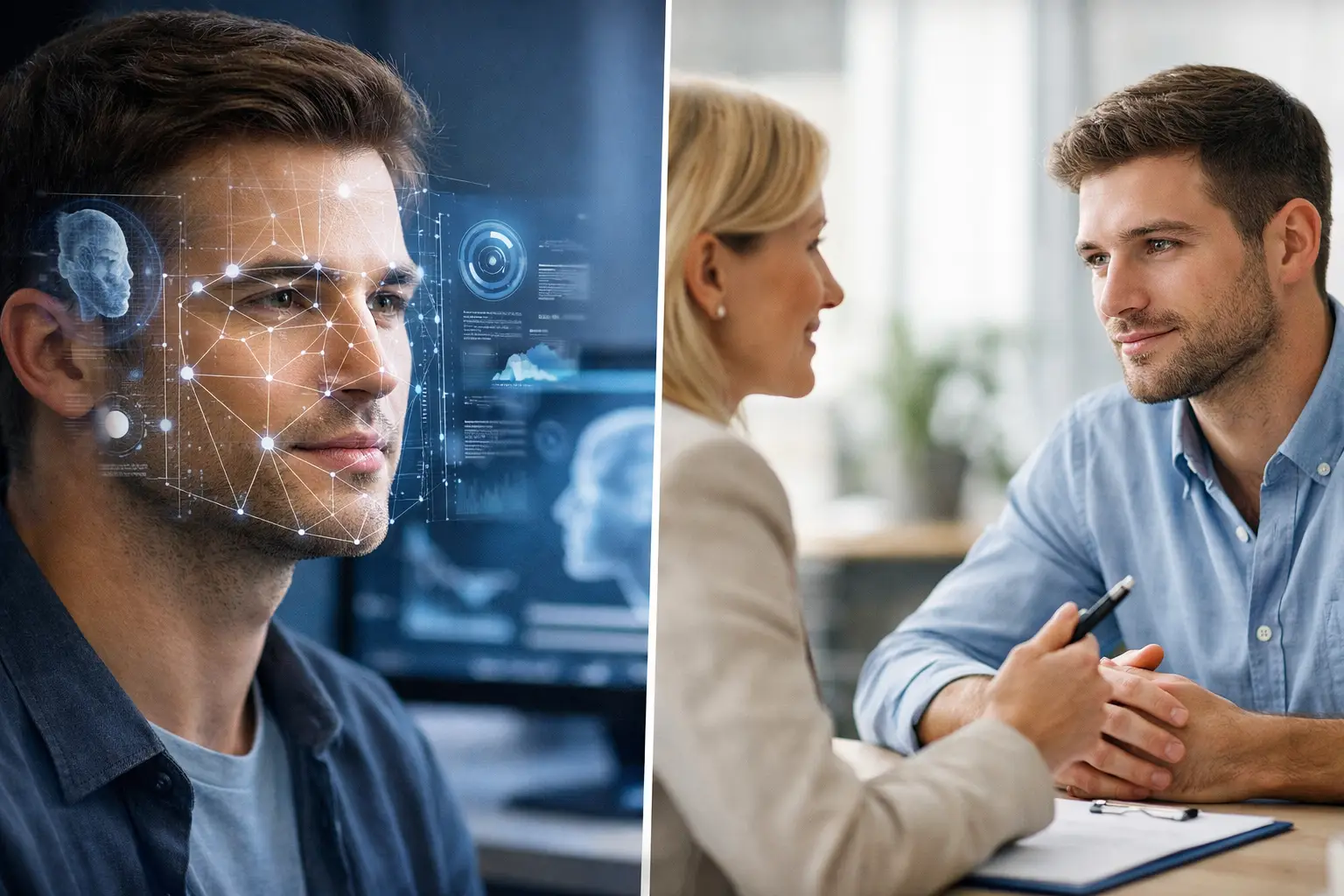
You do not always have time to book a coach, sit through intake calls, and wait for a polished read on personality, fit, or emotional patterns. That is exactly why the question of ai face scan vs professional coach assessment matters now. For hiring, team dynamics, relationship clarity, or personal growth, the real issue is not which option sounds smarter. It is which one gives you useful signal at the right moment.
A lot of people assume this is a fight between machine precision and human wisdom. That is too simple. An AI face scan and a professional coach assessment solve different problems, move at different speeds, and create different kinds of confidence. If you want a clean answer, here it is: neither replaces the other in every case. But one will usually fit your situation better.
AI face scan vs professional coach assessment: what changes in practice
An AI face scan is built for rapid pattern extraction. You upload or confirm an image, the system analyzes visible facial structure and expression markers, and you receive a structured report. The value is speed, repeatability, and easy output. It is especially attractive when you need an immediate read, want something shareable, or prefer a guided process over a long back-and-forth.
A professional coach assessment works differently. A coach typically combines observation, interview context, behavioral interpretation, and lived experience. The result can be more adaptive and more nuanced in areas where biography, goals, and contradictions matter. A coach can ask follow-up questions. A system cannot improvise empathy in the same way.
That difference shapes everything. AI is strongest when you need a first-pass read at scale or on demand. Coaching is strongest when the real issue sits below the surface and requires interpretation through conversation.
Where an AI face scan wins
The biggest advantage is speed. A professional assessment often requires scheduling, preparation, and budget approval if it is being used in a team or business setting. An AI scan compresses that process into minutes. For busy managers, recruiters, founders, and curious consumers, that matters more than people like to admit.
The second advantage is consistency. Human coaches bring talent, but they also bring mood, bias, style, and framing. One coach may focus on emotional resilience. Another may over-index on communication style. AI systems apply the same analysis framework every time. That does not make them perfect, but it does make them stable. If you are comparing multiple people under one method, repeatability is a serious asset.
The third advantage is packaging. A strong AI platform does not just produce raw observations. It turns analysis into a clean report with defined sections, pattern language, and practical interpretation. That format makes the output easier to review, share, revisit, and use in professional settings. For users who want clarity without a long debrief, this is a major advantage.
There is also a psychological benefit. Some users answer differently when a human is present. They perform. They filter. They manage impressions. A scan-based system starts from visible input rather than self-description, which can feel more objective to people who distrust questionnaires or coaching talk.
Where a professional coach assessment wins
A coach has one ability AI does not fully replicate: context-sensitive judgment in real time. If your behavior at work conflicts with your behavior in relationships, a coach can explore why. If your self-image is distorted by stress, grief, burnout, or recent conflict, a coach can catch that and adjust. AI can identify patterns, but it does not hold a live conversation about your contradictions.
This matters most when the stakes are personal and layered. Career reinvention, leadership breakdowns, team conflict, and relationship repair often involve history, not just pattern recognition. A coach can challenge your assumptions, notice resistance, and respond to what is not being said. That is not just analysis. That is intervention.
Professional coaches can also calibrate delivery. Some people need direct feedback. Others need a softer approach or more explanation before insight turns into action. A report can be elegant and sharp, but it cannot sense when a person is defensive or confused in the moment.
So if your goal is transformation rather than signal, coaching often has the edge.
Accuracy is not one thing
People ask which option is more accurate, but that depends on what you mean by accurate. If you mean consistent pattern output from the same type of input, AI may outperform a human simply because it applies the same model every time. If you mean deep understanding of a person across goals, trauma, ambition, and current life stage, a skilled coach has access to dimensions an image-based system cannot directly see.
That is the trade-off. AI is narrow but efficient. Coaching is broad but variable.
This is why bold claims should be handled carefully. An AI face scan may generate strong personality signals and emotional tendencies with impressive speed. A coach may produce richer developmental advice after a one-hour session. Those are not identical deliverables. Comparing them as if they are the same instrument creates bad decisions.
The best use cases for each option
If you are screening for first impressions, exploring compatibility, getting a fast read on interpersonal style, or building a lightweight layer of team insight, AI is often the better choice. It is fast, accessible, and easy to deploy without coordination overhead. This is where platforms built around structured methods, guided scan workflows, and PDF-ready reporting stand out. They remove friction and turn curiosity into usable output.
If you are working through a leadership issue, a repeated team conflict, a major life transition, or a growth plan that requires accountability, hire the coach. Human interpretation is more valuable when follow-up questions change the meaning of the answer.
Many smart users do both, just not at the same stage. They use AI for signal first and coaching second. That sequence makes sense. A face scan can surface personality architectural cores, tension points, and probable dynamics quickly. Then a coach can pressure-test those findings in live discussion. Used this way, AI does not compete with coaching. It sharpens it.
Cost, access, and speed matter more than people admit
There is a status bias in assessment. Some people assume the more expensive, slower option must be more serious. That is not always true. Sometimes the right answer is the one you can actually use today.
A professional coach assessment can be excellent, but it comes with higher cost and scheduling friction. It may also vary significantly depending on the coach's method and skill. An AI face scan is available on demand, usually at a lower price point, and produces immediate structure. For users who need quick decision support, those are not minor benefits. They are the reason the tool gets used.
That is especially true for managers and recruiters. When you need directional insight across several candidates or team members, waiting weeks for interviews is not practical. A systemized AI layer gives you speed without requiring everyone to stop their workday for an assessment session.
AI face scan vs professional coach assessment for teams and hiring
This is where the comparison gets sharper. In team settings, consistency and scale have huge value. A coach can offer excellent insights in leadership development or conflict resolution, but coaching does not scale neatly across broad, early-stage evaluation. AI does.
For hiring, AI should not be treated as a final verdict. It is stronger as a decision-support layer that adds personality signals, communication tendencies, and compatibility hypotheses. Think of it as pattern intelligence, not absolute truth. A coach, by contrast, is rarely involved at that volume unless the role is senior and the stakes justify the time.
For team building, AI reports can create a shared language fast. People engage more readily when the analysis is structured, visual, and easy to discuss. A platform like SomaScan.ai leans into this well by turning facial analysis into a polished report rather than a vague personality claim. That matters because adoption is not just about quality. It is about whether people will actually use the output.
So which should you choose?
Choose an AI face scan when you want speed, consistency, low friction, and a report you can act on immediately. Choose a professional coach assessment when your situation is emotionally layered, context-heavy, or dependent on real-time dialogue.
If you are still unsure, use one test: ask what kind of problem you are solving. If you need signal, start with AI. If you need change, start with a coach. If you need both, start with the faster tool and use the slower one to deepen the picture.
The smartest assessments are not the ones with the most ceremony. They are the ones that match the moment, reduce uncertainty, and give you a clearer read on what happens next.