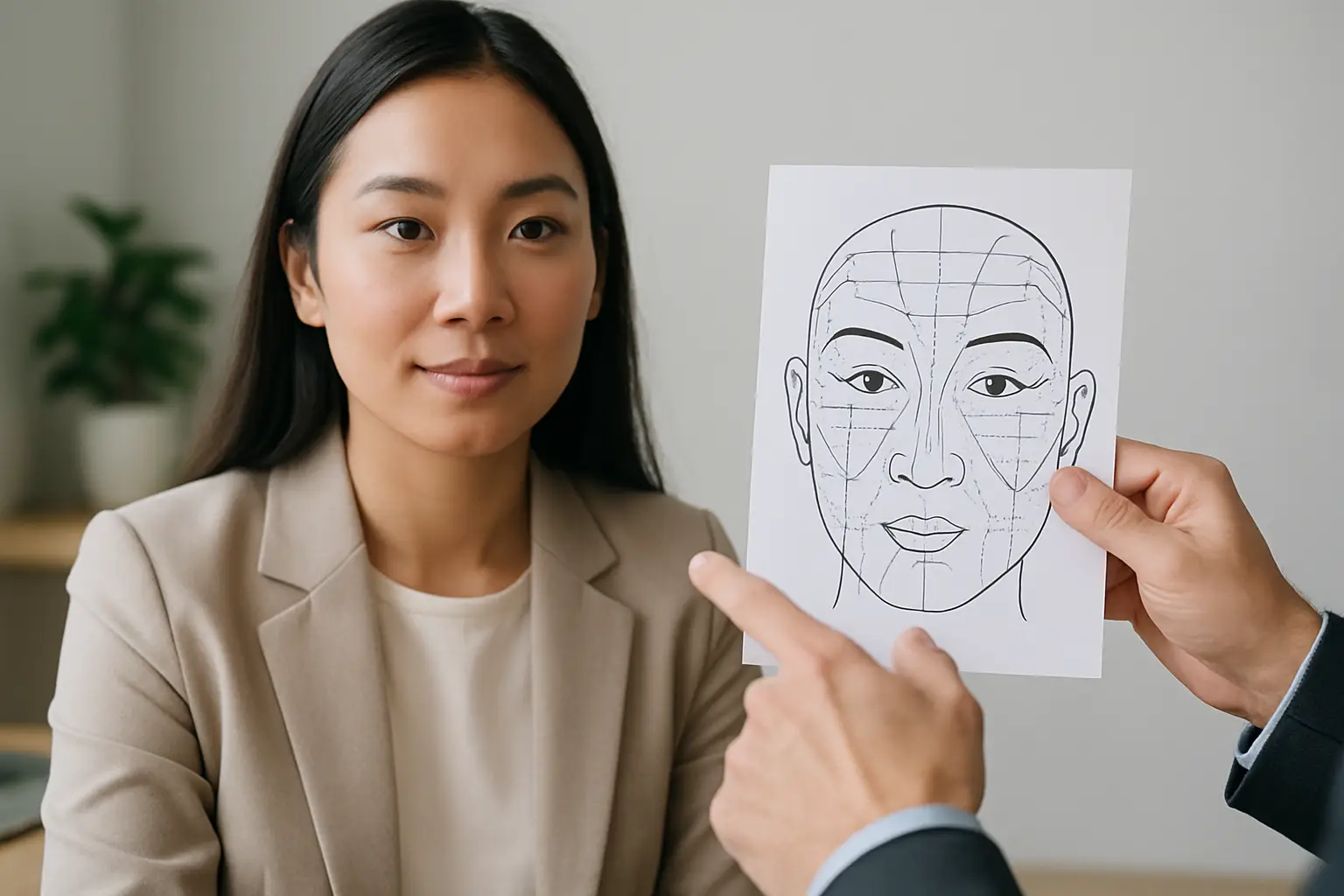
Most people can read a room in five seconds - but struggle to explain how they did it.
That gap between instinct and language is exactly why chinese face reading has survived for centuries. It turns vague impressions into a structured map: this feature suggests that tendency, that contour hints at that pattern, and a face isn’t “good” or “bad” so much as it’s organized a certain way.
If you’re a manager trying to predict team fit, a recruiter filtering for role alignment, or a high-performing professional tired of personality tests that feel like horoscope copy, the appeal is obvious: fast signals, readable frameworks, and a narrative you can actually use.
This article breaks down what chinese face reading is, what it’s trying to measure, how the core “maps” work, where it’s useful, and where you should not trust it.
What Chinese face reading is (and what it isn’t)
Chinese face reading is an observational tradition that links facial structures and conditions to temperament, behavioral tendencies, emotional patterns, and life-stage themes. In traditional contexts it’s often called Mian Xiang, and it’s typically paired with other systems (like Five Elements) to describe how a person tends to act under pressure, pursue goals, or relate to authority and intimacy.
What it is: a structured way to translate visible features into likely patterns. It’s closer to pattern recognition than mind-reading.
What it is not: a scientific diagnosis, a moral verdict, or a guarantee that a person will behave a certain way. If anyone sells it as certainty, they’re overselling. Faces change with sleep, stress, illness, weight shifts, and age. Good readers treat it like probabilistic signal, not destiny.
There’s also a major distinction people miss: traditional face reading isn’t only about fixed structure. It also looks at “condition” - things like color, tension, puffiness, dryness, and overall vitality. Structure tends to be stable. Condition is often a temporary dashboard.
Why this system still attracts modern high-performers
Let’s be blunt: most modern “people-reading” happens in high-stakes settings with low patience. Interviews, first meetings, client calls, team reshuffles, dating, leadership transitions. You don’t get a month to observe someone. You get minutes.
Chinese face reading fits that reality because it offers three things busy people keep paying for:
First, speed. The face is the first data source humans naturally use.
Second, language. It gives you a vocabulary for something you already sense but can’t articulate.
Third, integration. The good versions don’t isolate one feature. They combine multiple signals into a coherent profile. That makes it more useful than one-off “your eyebrows mean you’re creative” content.
The value isn’t that it’s mystical. The value is that it’s systematic - and system beats vibes when you’re making decisions.
The core map: the face as zones
One of the most common frameworks divides the face into three broad zones that roughly track life phases. Different schools describe this slightly differently, but the high-level idea stays consistent.
The upper zone (forehead) is often associated with early life, guidance received, and how someone processes planning and principles.
The middle zone (eyes to nose) tends to map to prime adult years - execution, ambition, social navigation, and how a person handles complexity.
The lower zone (mouth to chin and jaw) is commonly linked to later life themes - stamina, material stability, groundedness, and the “finish” energy of a person: follow-through, resilience, how they land the plane.
Here’s how to use that map without getting lost in folklore: compare zone strength. When one zone is visually dominant, it often indicates where a person naturally leads.
A strong upper zone can correlate with planning, strategy, and rule-based thinking.
A strong middle zone often correlates with engagement, visibility, and influence.
A strong lower zone can correlate with endurance, practicality, and long-term staying power.
None of those are virtues by default. They’re advantages in the right role and liabilities in the wrong one.
The Five-Element lens: how “energy types” show up
A big reason chinese face reading feels coherent is that it often uses a Five-Element lens to organize traits. You don’t need to memorize a textbook version of Wu Xing to benefit from the logic.
Think of it as five temperament families that show up as shape tendencies. In practice, most people are blends, with one or two dominant notes.
Wood: growth, drive, and forward pressure
Wood types often read as upward and expanding. There can be a sense of length, lift, or directional push.
At their best: motivated, future-oriented, decisive, and hard to stall.
Under stress: impatient, rigid, easily frustrated by inefficiency.
In teams: great for building and scaling, but they need autonomy and clear targets.
Fire: expression, speed, and social heat
Fire reads as animated. The eyes often look bright, the face can feel “alive,” and the expression changes quickly.
At their best: inspiring, persuasive, high-energy communicators.
Under stress: scattered, dramatic, impulsive, inconsistent follow-through.
In teams: excellent for momentum and morale, but they need structure to finish.
Earth: stability, care, and practical intelligence
Earth reads as grounded and centered. Features may appear fuller, softer, or balanced.
At their best: reliable, supportive, pragmatic, good at holding a system together.
Under stress: worry cycles, people-pleasing, resistance to change.
In teams: strong operators and culture anchors, but they need boundaries.
Metal: precision, discipline, and standards
Metal reads as defined. There’s often crispness in contours and a “clean” impression.
At their best: organized, principled, quality-driven, great with systems and compliance.
Under stress: harsh judgment, perfectionism, emotional suppression.
In teams: ideal for operations, risk, and process - but watch for rigidity.
Water: depth, strategy, and adaptability
Water reads as fluid and observant. There may be depth in the gaze or a more reserved expression.
At their best: strategic, intuitive, resilient, good in ambiguity.
Under stress: withdrawal, overthinking, secrecy, fear-based delay.
In teams: strong analysts and crisis navigators - but they need psychological safety.
This is where the system becomes useful for modern contexts: you’re not labeling someone as “good.” You’re anticipating friction points, motivation triggers, and communication style.
Feature-by-feature: what traditional readers actually look at
If you want to understand chinese face reading at a practical level, you need to know the major feature clusters. Not because one feature defines someone, but because combinations matter.
Forehead: planning style and learning curve
A broader, clearer forehead is often associated with planning capacity and openness to learning. A heavily lined or tense forehead can signal mental overwork, stress load, or a person who lives in their head.
This is not “smart vs not smart.” It’s about how a person tends to process decisions: internally, slowly, strategically - or quickly, reactively, through experience.
Eyebrows: drive, boundaries, and social posture
Eyebrows are often read as indicators of will, standards, and how a person relates to rules.
Thicker, more defined brows can correlate with stronger opinions and higher drive. Sparse or very light brows are sometimes associated with flexibility, sensitivity, or lower interest in dominance games.
A key nuance: grooming and style can change the signal. That’s why you don’t read eyebrows in isolation. You read them in context with eyes, jaw, and mouth.
Eyes: attention, emotional transparency, and pace
Eyes are central in face reading because they show both structure and condition. A steady gaze can indicate focus and confidence. A darting gaze can suggest high scanning behavior: alertness, anxiety, or strategic monitoring.
Brightness, redness, puffiness, and tension often reflect current state more than personality. This matters in interviews. Someone can be brilliant and exhausted.
If you’re using face reading professionally, you should separate “today state” from “baseline pattern.”
Nose: ambition, resource management, and execution
Traditional frameworks often link the nose to ambition, career drive, and how someone handles resources.
A more prominent bridge can correlate with confidence in authority and direction. A softer nose can correlate with adaptability and a collaborative style.
Again, don’t moralize it. In hiring, the question isn’t “who has the best nose.” It’s “who matches the role’s decision rhythm?”
Cheeks and cheekbones: influence and social leverage
Cheekbones often get read as a proxy for assertiveness and social power. Higher, more defined cheekbones can signal a person who holds boundaries and can manage conflict. Less pronounced cheekbones can signal a more accommodating style.
In leadership, cheekbone signal is a double-edged sword. Strong leverage can create respect. It can also create intimidation if not balanced by warmth cues (mouth, eyes, facial tension).
Mouth and lips: communication and desire
The mouth is often read for how a person expresses needs, negotiates, and manages pleasure-seeking vs restraint.
Fuller lips are commonly linked with expressiveness and relational warmth. Thinner lips are often linked with restraint and selective disclosure.
What matters more than fullness is tension. A tight mouth can indicate control, suppression, or stress. A relaxed mouth often indicates openness.
Chin and jaw: stamina and follow-through
Jawline and chin are commonly linked to persistence, groundedness, and the ability to finish.
A strong jaw can correlate with endurance and stubbornness. A softer jaw can correlate with flexibility and avoidance of direct confrontation.
For team roles: execution-heavy positions often benefit from stronger “finish” signals, but the best teams balance finishers with initiators.
Condition signals: what the face says about the last 30 days
One of the most practical parts of chinese face reading is condition reading, because it keeps you honest. People aren’t just their traits. They’re their current load.
Dullness, puffiness, and tension often correlate with poor recovery and high stress. Dryness can correlate with overextension. Sudden breakouts or inflammation can signal hormonal or stress shifts. Dark under-eye shadow can be sleep debt, but it can also be genetics - so you check for change over time.
If you’re a coach or manager, this matters more than symbolism. A high-potential person in a depleted state will look “off.” The correct move isn’t to label them as unstable. The correct move is to adjust expectations, support recovery, or delay high-risk decisions.
Where face reading helps in real life (without turning weird)
Used responsibly, face reading can be a high-speed hypothesis generator.
In hiring and team building, it can help you anticipate communication friction: who needs clarity vs autonomy, who pushes vs stabilizes, who will challenge authority vs protect process. If you want a grounded take on using personality signals at work, read Team Building Gets Easier With Personality Signals.
In relationships, it can help you predict conflict style: who escalates, who withdraws, who negotiates, who stonewalls. Not to judge - to prepare. If you’re comparing tools and frameworks in this space, [AI Compatibility Tests: What They Get Right](/ai-compatibility-tests-what-they-get-right) lays out the difference between fun matches and useful pattern insight.
In personal development, it can give you a mirror that’s hard to ignore. A tense jaw and tight mouth are often visible to everyone except the person wearing them. Face reading makes blind spots discussable.
Where face reading fails (and why smart users set limits)
If you want this to be useful, you need boundaries. Here are the failure modes that make face reading inaccurate or unethical.
First, overconfidence. One feature never equals one trait. People who sell “single-trait certainty” are selling entertainment.
Second, ignoring context. Stress, grief, medication, lighting, camera distortion, and even recent travel can change the face’s condition signals.
Third, confusing correlation with destiny. Even if a feature correlates with a tendency, behavior is still shaped by training, values, incentives, and environment.
Fourth, using it to justify bias. Face reading should never be used to rationalize discrimination. If you’re making professional decisions, it must be one input among many, and it should never replace structured interviews, references, and performance evidence.
Fifth, mixing it with diagnosis. Face reading is not a medical tool. Don’t use it to claim health conditions.
If you’re evaluating modern automated tools, the right question is: does the system clearly separate stable structural tendencies from temporary condition cues, and does it present outputs as patterns rather than guarantees? That standard filters out a lot of nonsense.
The modern shift: from intuition to engines
Traditional face reading is human-observed and experience-driven. Modern face reading attempts to standardize the observation process.
The benefit is consistency. A structured system can reduce the “reader mood” problem where interpretations vary wildly depending on who’s looking.
The trade-off is that any automated approach is only as good as its mapping logic and the quality of its inputs. Bad lighting and extreme angles create bad reads. Overly generic frameworks create generic reports.
The best modern systems do three things well: they run multi-angle pattern extraction, they layer multiple frameworks (structure, expression, balance, element mapping), and they produce outputs in language that a human can act on - not just raw measurements.
If you want a clear explanation of the mechanics behind automated approaches, How AI Face Reading Actually Works breaks down the workflow without the fantasy talk.
How to use chinese face reading like a professional (not a tourist)
Start with a simple rule: read for tendencies, then verify with behavior.
If a face suggests high drive and low patience, watch how the person handles ambiguity, delays, and low-urgency tasks. If the behavior contradicts the signal consistently, trust behavior.
Use combinations, not single cues. For example, a strong jaw with a relaxed mouth often reads as persistent but fair. A strong jaw with a tight mouth can read as persistent and controlling. Similar structure, different emotional posture.
Separate “baseline” from “today.” A person in a high-stress season may show tension and dullness that disappear after recovery.
And keep it role-specific. The same pattern can be a strength in one job and a risk in another. High fire expression can be perfect for sales and chaotic for compliance. High metal standards can be perfect for quality control and frustrating in early-stage creative work.
Common myths that keep people stuck
One myth is that face reading is only about beauty. It isn’t. Many signals have nothing to do with attractiveness and everything to do with tension, balance, and proportion.
Another myth is that you can’t change anything. While bone structure is stable, facial tension, expression habits, sleep patterns, stress load, and even confidence posture are trainable. Your “condition” is responsive to your life.
A third myth is that one reading tells the whole story. The face is one layer. A good assessment also considers communication behavior, decision history, and relational patterns.
A modern way to get a structured read fast
If you like the logic of chinese face reading but want it packaged as a clean, professional deliverable, that’s exactly why platforms like SomaScan.ai exist - guided identity anchoring, structured pattern frameworks, and a PDF-ready report designed for quick sharing and real-world conversations.
The point isn’t to replace judgment. The point is to give your judgment better handles.
FAQ: the questions people ask before they trust it
Is chinese face reading “real,” or is it just a vibe?
It’s real in the sense that it’s a structured tradition of observation with consistent internal logic. It’s not “real” in the sense of being a medical or psychological diagnosis. Treat it like a pattern lens: useful for hypotheses, weak for guarantees.
Can you read personality from a single photo?
You can extract some structural signals from a decent photo, but accuracy depends on angle, lighting, expression, and image quality. One photo also captures a momentary state. Multiple images or consistent capture conditions improve reliability.
What features matter most?
In most systems, the eyes (attention and emotional transparency), mouth (communication and tension), and jaw/chin (follow-through) carry a lot of signal. But the best reads come from integration - how features balance each other.
Is it ethical to use face reading in hiring?
It can be ethical only if it’s not used as a gatekeeping decision tool and never used to justify bias. If you’re considering it in a hiring workflow, use it as a conversation starter about working style, not as a pass-fail filter. For a deeper discussion of the trade-offs, AI Facial Analysis for Hiring: Worth It? lays out where it can help and where it can go wrong.
How do I avoid fooling myself?
Write down the pattern prediction before you interact deeply, then track whether behavior confirms it over time. Also, don’t interpret stress-face as personality. Condition signals can mimic traits.
Chinese face reading works best when you treat it like a high-speed map, not a verdict - a way to ask sharper questions, spot patterns faster, and make human judgment less blind.