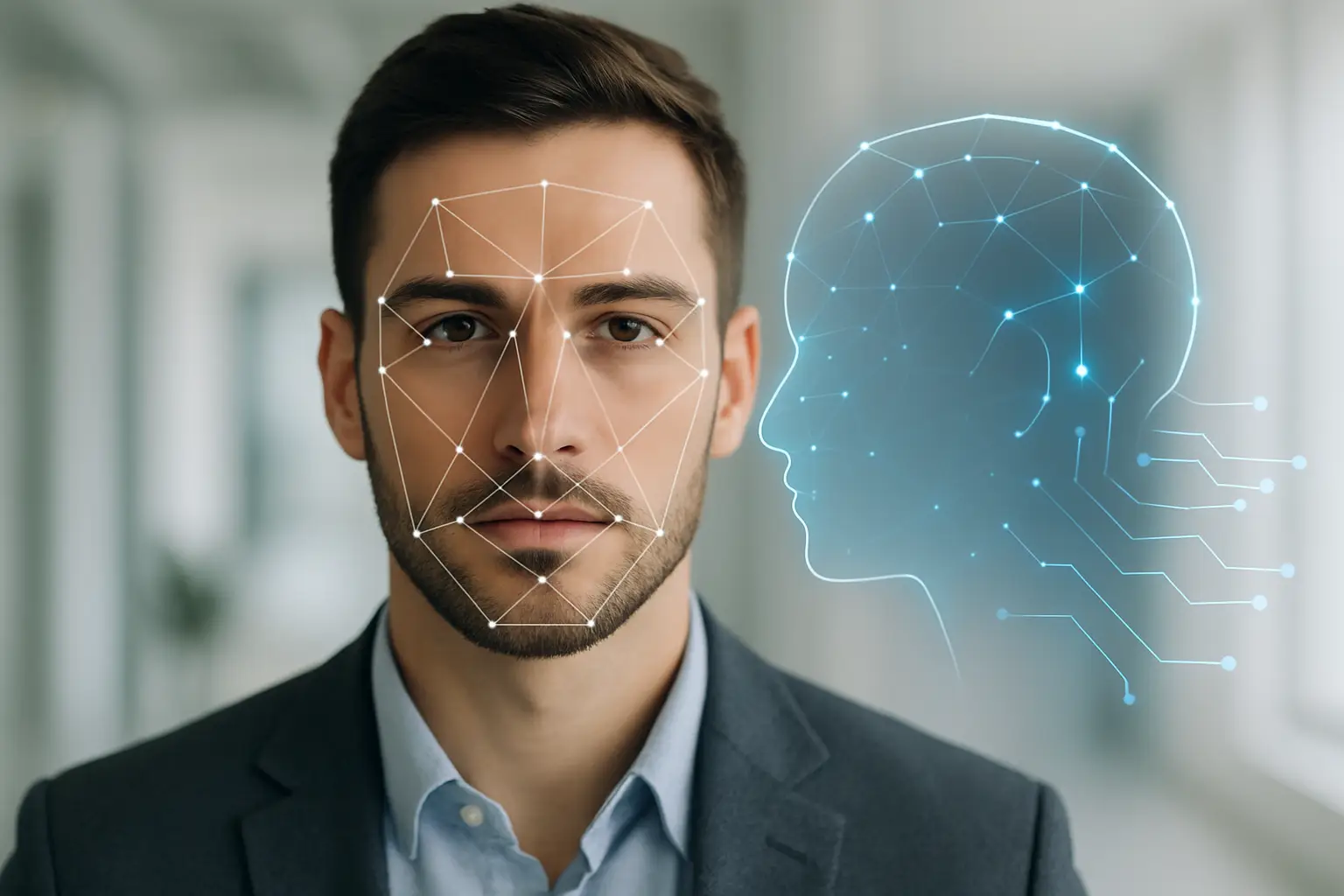
A manager screens two finalists who look identical on paper. A coach meets a new client who says all the right things. A dater gets “I’m fine” while the energy says otherwise. In those moments, people want fast signal - not a 90-question assessment and not a week of observation. That demand is why AI face reading exists: it’s a system designed to convert facial input into structured, repeatable insight you can act on.
But how does it work, really? Not as magic. Not as “the camera sees your soul.” AI face reading is a pipeline: acquire face data, standardize it, extract measurable structure, compare it to trained patterns, then translate the output into human language.
How does ai face reading work, step by step?
Most “face reading” platforms feel instantaneous because the heavy lifting happens behind the scenes. The process is usually a multi-stage engine, and each stage has a job to do.
1) Identity anchoring and input collection
Systems start by anchoring who is being analyzed. Sometimes that’s a user-uploaded photo. Sometimes it’s a guided workflow that begins with a name, then pulls in likely profile images tied to that identity.
This step is less glamorous than it sounds, but it matters. AI models are sensitive to context. A low-res selfie taken at a weird angle can produce different measurements than a straight-on, well-lit image. Good engines don’t just “take any photo” - they try to obtain enough usable views to reduce noise.
2) Face detection and alignment
Before an AI can interpret a face, it has to find the face.
Detection models locate the face region in an image. Alignment models then normalize it: they estimate head pose and rotate/scale the image so key points (like the eyes) sit in consistent positions. This is where the system tries to correct for tilt, distance from camera, and mild perspective distortion.
Alignment is the difference between measuring a structure and measuring a camera angle.
3) Landmarking: turning a face into coordinates
Next comes landmark detection. This is where the system marks facial reference points - corners of the eyes, nose bridge, nostrils, mouth corners, jawline curve, brow shape, and more.
These landmarks convert a face from pixels into a geometry map. Once you have geometry, you can calculate ratios, angles, symmetry, curvature, spacing, and proportional relationships. That’s the raw material that face-reading engines use to build “pattern signatures.”
Think of landmarks like scaffolding. The AI isn’t “guessing” from a vibe. It’s measuring repeatable structure.
4) Feature extraction: structure, texture, and expression cues
After landmarking, many systems extract deeper features using neural networks.
Some features are structural: jaw width relative to cheekbone width, midface length, brow-to-eye distance, mouth width, and the balance across facial thirds. Other features can include texture and micro-patterns (skin detail, contrast edges, contour cues), though those are more sensitive to lighting and image quality.
If the engine includes expression analysis, it may also estimate action units - small muscular activations that correspond to expressions like tension around the mouth, brow compression, or eye openness. That can be used to infer momentary emotional state cues in addition to baseline structure.
The important trade-off is stability. Structure tends to be more stable across time. Expression is more situational.
5) Pattern mapping: from measurements to “types”
This is where the platform’s methodology matters.
At the model level, the system compares your extracted features to learned patterns. In a purely academic setup, those patterns might predict age or emotion. In a consumer “face reading” setup, the patterns are often mapped into higher-level constructs: temperament tendencies, social style signals, stress responses, communication preferences, and compatibility friction points.
Platforms create proprietary frameworks because frameworks let an engine do two things at once: keep internal scoring consistent and produce a report that feels interpretable to humans.
A typical mapping layer includes:
- Structural archetypes (how the face’s geometry clusters across a population)
- Balance and dominance signals (which regions are most visually pronounced)
- Variability signals (how strongly a person expresses a pattern vs. sits near neutral)
- Cross-feature interactions (combinations matter more than a single measurement)
This is why a serious engine doesn’t rely on one trait like “strong jaw = leadership.” Real systems score many variables and look for converging signals.
6) Language generation: turning scores into a report
Once the system has internal scores and pattern labels, it translates them into a narrative: personality tendencies, emotional patterns, likely motivators, stress behaviors, collaboration style, and compatibility notes.
This is usually done with a template-plus-generation approach. The engine selects the right modules based on your pattern profile, then generates readable output that sounds like a professional assessment.
Done well, this layer is specific without pretending to be omniscient. It uses confident language, but it should also stay inside what the signals can support.
Why lighting, angles, and “one good photo” still matter
AI face reading is not the same as face recognition.
Face recognition asks, “Is this the same person?” Face reading asks, “What patterns are present in the structure and expression cues?” That second question is more sensitive to input quality.
If a photo is heavily filtered, shot with a wide-angle lens up close, or taken from below, the geometry can be distorted. Good systems try to normalize, but normalization has limits. The cleanest analyses come from clear, front-facing images with neutral lighting and minimal obstruction.
This is also why multi-image discovery workflows can be useful. More views can reduce the odds that a single angle becomes your entire profile.
What AI can infer well - and what it can’t
A credible answer to “how does ai face reading work” has to include constraints.
AI can be consistent at measuring facial structure and describing pattern clusters. It can also be fast at generating structured interpretations that people find actionable for communication, team dynamics, and self-reflection.
What it cannot do is prove causality. A facial ratio doesn’t “cause” a personality trait. The engine is working with correlations, pattern groupings, and interpretive frameworks.
It also can’t guarantee context. If someone is sleep-deprived, stressed, or posing, expression cues can shift. And cultural, medical, or cosmetic factors can influence facial appearance in ways the system may not fully separate.
So the right way to use an AI face reading report is as a high-speed signal layer. It’s a conversation starter, a lens, and a decision-support input - not a replacement for judgment.
Why people use face reading for compatibility and career signals
Most users aren’t looking for trivia. They want clarity.
In professional settings, face reading is often used to anticipate collaboration style: who prefers directness, who needs time to process, who moves fast and gets impatient, who smooths conflict, who escalates it. In hiring, it can provide a structured “first read” to pair with interviews and references.
In personal settings, it’s about relational friction and fit. The report language gives people a way to talk about patterns like emotional guarding, intensity, attachment habits, or communication rhythm without turning it into a therapy session.
The value is speed and structure. You get a digestible, shareable narrative that helps you ask better questions.
The proprietary-method effect: why frameworks matter
Consumers don’t want raw coordinates. They want meaning.
This is where branded systems and versioned methodologies show up - the idea that there’s an engine with defined stages, not just a generic model output. When a platform names its layers (pattern analysis versions, integrity scoring, mapping systems), it signals repeatability. It tells the user, “This isn’t a horoscope generator. This is an assessment system with internal logic.”
That doesn’t mean the framework is infallible. It means the experience is organized enough to be used.
If you want to see what a productized, PDF-ready workflow looks like, SomaScan.ai positions its process like an engine: guided discovery, neural-style scanning, and a structured report built for personal and professional use.
FAQs people ask before they trust it
Is AI face reading the same as emotion detection?
No. Emotion detection focuses on momentary expressions. Face reading tends to focus on baseline structure plus optional expression cues. If a system claims it can read your permanent personality from a single smile, that’s usually marketing, not methodology.
Can it work from one photo?
It can, but results depend on photo quality and angle. The more standardized the image, the more stable the measurements. Multi-image workflows generally reduce noise.
Is it “scientifically proven” like a clinical test?
Most consumer face reading products are not clinical diagnostics. They operate as pattern-based interpretation engines. Treat them as decision support and self-insight tools, not medical or psychological evaluations.
What about bias and fairness?
Any model trained on uneven data can produce uneven outputs. Better platforms manage this through dataset diversity, conservative claims, and structure-first measurement rather than vibe-based judgment. The user should still apply common sense and avoid using a single report as the final word on someone.
If you’re using AI face reading the right way, you’re not trying to replace human perception. You’re upgrading it. Let the system give you a structured first read, then use that clarity to ask sharper questions, communicate with less friction, and make decisions that actually hold up in the real world.