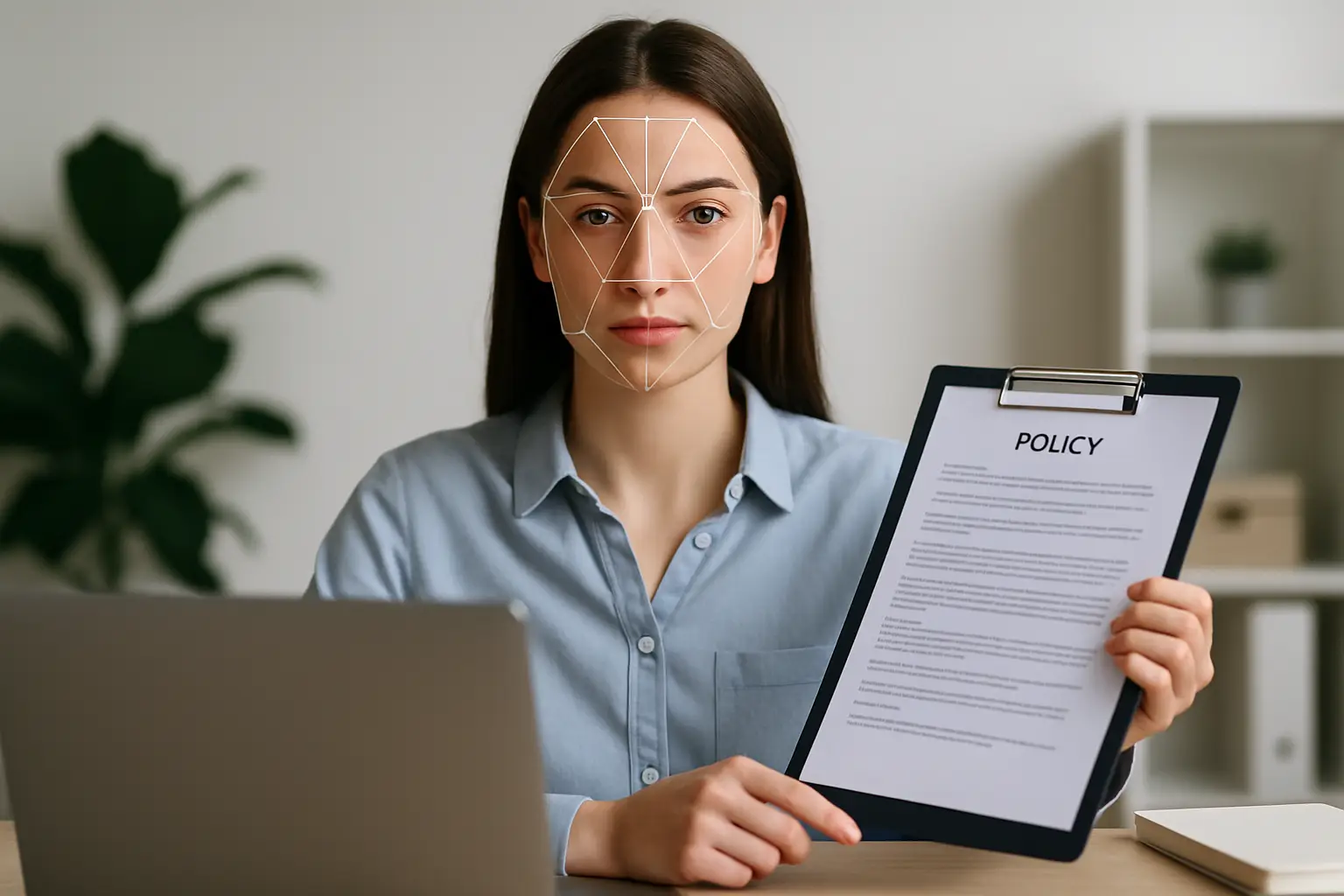
You can sell a face analysis report in minutes. You can also lose a customer in seconds the moment they wonder, “Wait - what happens to my photo?”
That question is the center of your conversion rate and your compliance risk. Face data feels personal in a way email addresses never will. A tight, confident ai face analysis privacy policy is not legal wallpaper - it is product UX. It tells users what you do, what you do not do, and how they stay in control.
This is a practical, product-led blueprint for writing a privacy policy for AI face analysis that reads like a serious engine - not a shrug.
What an ai face analysis privacy policy must actually do
A privacy policy for a face analysis product has two jobs at the same time.
First, it has to be accurate. If you collect a selfie, infer attributes, store results, or send anything to vendors, your policy has to match reality. The fastest way to create trouble is to publish a policy your engineering team would call “aspirational.”
Second, it has to reduce uncertainty at the exact moment the user is deciding whether to upload a face image. That means fewer vague phrases like “may” and more direct statements like “We store X for Y days to do Z.” Clear beats long. Specific beats broad.
Trade-off: you will be tempted to keep language general so you can change the product later. But with biometric-adjacent data, over-broad language can feel like a blank check. Users interpret ambiguity as risk.
Define your data categories like a system, not a blog post
If your product uses a guided scan workflow, your policy should mirror that workflow. Users understand steps. They do not understand generic “information we collect” sections that read like they were copied from an ecommerce site.
Start by naming categories in plain English, then specify examples.
Identity anchors and account signals
If you ask for a name to “anchor identity,” say whether that name is required, whether it becomes part of the report, and whether it is stored with the scan. If you also collect email for delivery, password for an account, or device identifiers for fraud prevention, list them.
Face images and face-derived data
This is where most privacy policies collapse into mush. Separate what the user uploads from what your system generates.
A strong approach is: “Face Images (uploaded or discovered)” versus “Face Analysis Outputs (model-generated).” Then clarify what “outputs” means in your product - traits, compatibility insights, confidence scores, embeddings, landmarks, or classification labels.
Even if you do not expose those intermediate artifacts to users, you should still decide whether you create them and whether you store them. If you don’t store them, say so clearly.
Behavioral and technical data
If you track how users click through the scan funnel, use cookies, or run analytics, keep it honest and proportionate. The moment you bundle “selfie” and “advertising pixels” in the same paragraph, trust drops. Put technical tracking in its own section.
Consent has to be explicit, not implied by a button
With face analysis, “By using the service you consent…” is not enough for a user who is about to upload someone else’s photo or run a team-building experiment.
Your policy should align with an in-product consent moment that is unmissable: a checkbox or clear language near upload, paired with a link to the policy.
Spell out three things:
- What the user is authorizing (analysis to generate the report).
- Whose face can be used (only the user, or also third parties with permission).
- What happens if they refuse (they cannot run the scan, or they can still browse).
“It depends” scenario: if you allow scanning public figures or people the user does not personally know, your policy needs an extra layer on lawful basis and source of images. Most consumer products are safer when they restrict uploads to people who have consented.
Purpose limitation: name the purpose, then name the non-purpose
Users do not only want to know what you do. They want to know what you won’t do.
For face analysis platforms, the cleanest trust builder is a short “We use your data to…” section followed by “We do not…” statements that are true.
Examples of high-impact non-purposes, if accurate for your product:
- You do not sell face images.
- You do not use uploaded images to train public models.
- You do not run facial recognition to identify a person by matching them to a database.
Be careful: if you say you do not train models, but your team uses uploads for fine-tuning, QA, or evaluation, you need to either stop doing that or describe it with an opt-in.
Retention: the simplest question users ask
“How long do you keep my photo?” is the question that decides whether many users proceed.
A credible ai face analysis privacy policy gives retention in timeframes, not vibes. The best structure is to separate retention for:
- Uploaded images
- Generated reports and analysis outputs
- Payment records (which may be retained longer for tax and accounting)
- Support messages
If you keep photos only long enough to generate the report, say “We delete face images within X hours/days after report generation, unless you choose to save your scan history.” If you offer “scan history,” let users opt out and still purchase.
Trade-off: shorter retention can increase your operational costs (re-runs, fewer cached results). But it reduces risk, and risk is expensive.
Vendors and subprocessors: be direct about who touches the data
Most AI products rely on third parties for hosting, analytics, payments, email, and sometimes model inference. A privacy policy should not pretend you do everything in-house.
The standard that earns trust is: name categories of vendors, explain what they do, and state that they are bound by contractual obligations.
If you can maintain a live “subprocessor list” page later, great. But even without it, your privacy policy can specify: cloud hosting provider, payment processor, email delivery vendor, customer support tools, and any AI inference providers.
If any vendor can access face images, say so. If face images are encrypted and access is limited, say that too - but only if it is operationally true.
Security language: confident, specific, not theatrical
Users do not need a paragraph of generic “industry standard” claims. They need to know you treat face data as high-sensitivity.
Good security statements include basics that signal competence: encryption in transit, access controls, least privilege, logging, and secure deletion practices. If you segment data so face images are stored separately from identity info, that is a meaningful detail.
Avoid overpromising. “We guarantee security” is a legal and trust problem. Say you take “reasonable” or “appropriate” measures, then list what those are.
Biometrics and US state laws: don’t hide from the hard part
In the US, several states treat biometric identifiers and biometric information as a special category. Whether your face analysis counts as “biometric” depends on what you do with the image, what identifiers you generate, and your jurisdictional exposure.
Your privacy policy should acknowledge the category even if your interpretation is that you do not perform biometric identification. The key is clarity: do you create face templates or embeddings that can be used to identify someone across scans? Do you run recognition? Do you merely analyze features to generate a personality-style report?
If you operate in or market to states with biometric privacy frameworks, consider including a dedicated section that addresses notice, consent, retention, and deletion in one place. Even if you keep it short, calling it out signals seriousness.
“It depends” scenario: if you store face embeddings to allow users to re-run reports without re-uploading, you may be moving closer to biometric processing. If you want a simpler posture, do not store persistent identifiers.
User rights: give real controls, not a support maze
A modern privacy policy should state what users can do with their data and how fast you respond.
At minimum, cover access, deletion, correction, and portability where applicable. Then add the face-specific controls users actually care about: deleting the uploaded image, deleting scan history, and disabling any optional data use such as product improvement.
Be explicit about how requests are handled: in-account controls where possible, and a contact method where not.
If you have to keep some data (payments, fraud logs), say that deletion has limits. Users can accept limits when you explain them.
Handling third-party images: the line that prevents abuse
Face analysis tools attract “scan my coworker” behavior. Your privacy policy should make your stance unambiguous.
If you require that users only submit images they own or have permission to use, say it. If you prohibit scanning minors, say it. If you prohibit harassment, say it.
This is not only ethics. It is risk containment. Your policy sets the rule that allows you to terminate misuse and respond to complaints.
Product-led placement: where the policy should show up
A privacy policy that users never see is not doing its job.
Put it at three points: footer for completeness, upload step for decision timing, and purchase step for reassurance. Pair it with a one-paragraph “Privacy at a glance” summary right next to the upload box. The summary should match the full policy exactly.
If your product positions itself as a professional-grade engine with named frameworks and versioning, your privacy policy should share that same tone: direct, structured, and specific.
SomaScan.ai publishes its product experience around speed and a clean, PDF-ready report. If you’re building in that category, a policy that reads like a serious system is part of the deliverable, not an afterthought. You can see how the brand presents the scan workflow at https://somascan.ai.
FAQs that remove the last objections
Do you sell my face image or analysis results?
If the answer is no, say no with zero hedging. If the answer is “we share with service providers,” say that and define “service providers.” Users understand vendors. They do not accept “partners” as a mystery box.
Will my photo be used to train your AI?
If training happens, make it opt-in. If it never happens, state that clearly. If you use de-identified samples for quality assurance, explain what “de-identified” means and what you remove.
Can I delete my scan?
Give the method and timeframe. If deletion is immediate for images but delayed for backups, say that. Users can handle technical reality when you speak plainly.
Do you do facial recognition?
If you don’t identify people by matching them to a database, say that directly. If you do, you need a separate, more stringent consent and a clear user benefit.
A privacy policy is not your legal team’s chore. It is your product’s credibility layer, written in plain English, timed to the moment of upload, and backed by retention choices your engineers can defend tomorrow.