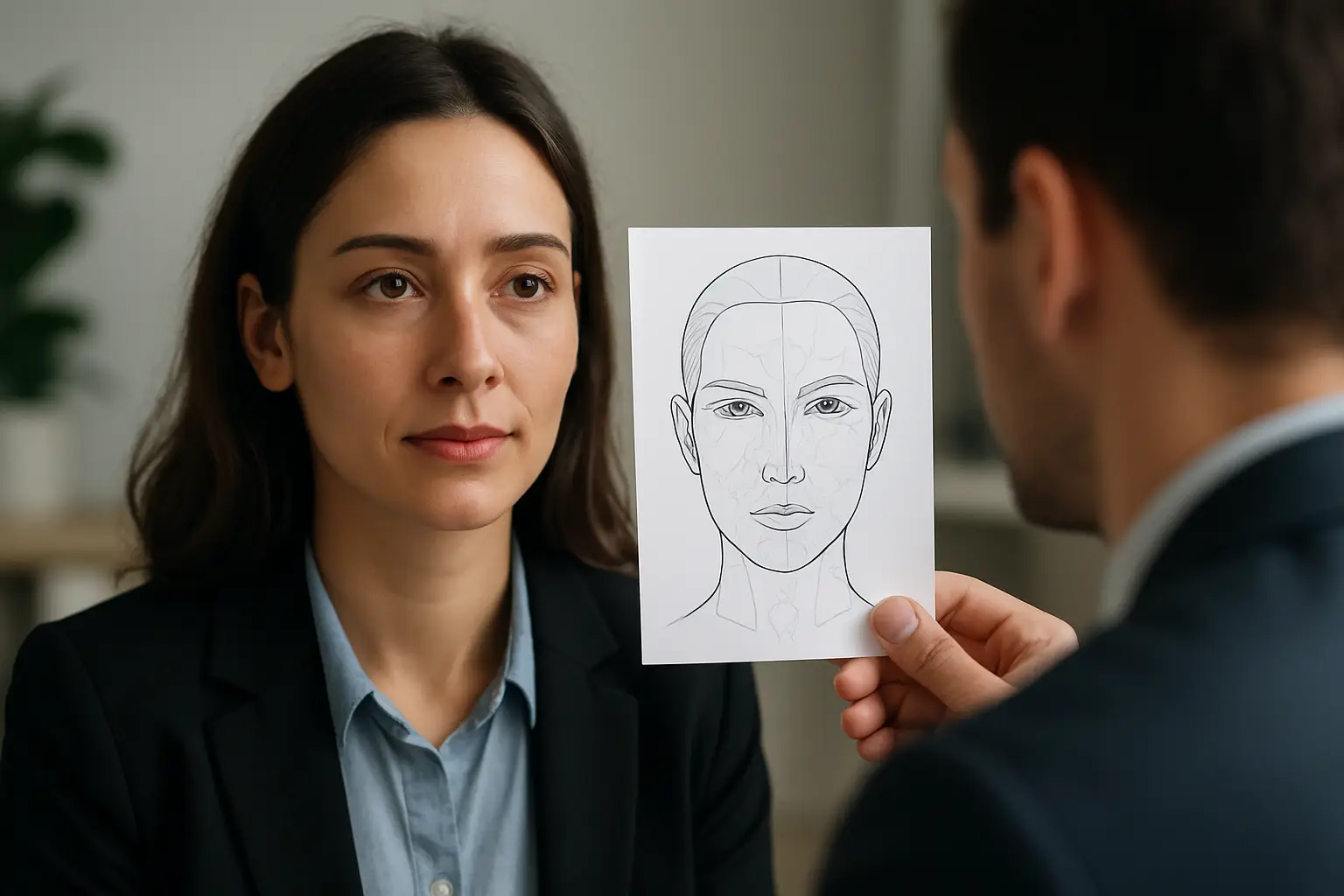
You have seen it happen in real time: someone walks into a room, says three words, and everybody quietly forms an opinion. Competent. Guarded. Warm. High-strung. The human brain is a pattern engine, and the face is the highest-bandwidth signal we get in the first five seconds.
So the question is not whether people read faces. They do. The real question is whether those reads hold up as personality prediction - and what “prediction” even means when you are making decisions about hiring, collaboration, leadership, or compatibility.
Does face reading predict personality - or just perception?
If you define prediction as “I can look at a face and know your Big Five scores with lab-grade accuracy,” you are asking for a level of precision that no fast read - facial, verbal, or otherwise - consistently delivers.
If you define prediction as “I can extract repeatable signals about temperament, emotional defaults, and interpersonal tendencies that are useful in the real world,” the answer becomes more practical: face reading can produce directional insights, especially when it is structured, consistent, and used as decision support rather than a verdict.
That distinction matters. In professional settings, most people are not trying to diagnose. They are trying to reduce uncertainty. They want faster clarity on how someone is likely to communicate under pressure, how they react to conflict, whether they prefer autonomy or collaboration, and what kind of environment they will thrive in.
Face reading sits in that zone: a high-speed signal system that can inform a hypothesis about personality patterns. Used correctly, it is not “magic.” It is structured pattern recognition applied to a human interface that carries a lot of social and biological information.
Why people believe face reading works
Face reading persists across cultures and centuries because it scratches a real itch: people need a quick way to predict behavior when the cost of being wrong is high. In hiring, a mismatch drains time and morale. In relationships, misreading emotional patterns creates friction. In leadership, misunderstanding a team member’s stress behavior can break trust.
There are also three reasons face-based judgments feel unusually convincing.
First, faces are stable. Compared to mood, clothing, or small talk, facial structure and baseline features feel like a “ground truth,” even when the interpretation is wrong.
Second, people are trained by repetition. Over a lifetime, you associate certain expressions and micro-cues with outcomes. Someone who consistently looks tense might have been tense. Someone who consistently looks open might have been approachable. Your brain turns that into a shortcut.
Third, confidence sells. Any system that outputs a crisp narrative about your “core traits” will feel more accurate than a vague statement like “it depends.” Most assessments fail not because they are inaccurate, but because they are hard to use. Face reading, especially in a productized report format, is easy to share, easy to act on, and feels concrete.
What face reading can realistically capture
Let’s be direct: a face does not contain your life story. It does not reveal your ethics, your values, or your competence. It does not “prove” honesty, intelligence, or loyalty.
What it can do, when approached as a structured model, is surface tendencies tied to expression defaults, tension patterns, and the way you carry emotion.
In real-world terms, that means face reading is better at:
- Spotting baseline emotional tone (calm vs charged) and how quickly someone seems to shift under stress
- Indicating interpersonal style signals (reserved vs outward, guarded vs open, direct vs diplomatic)
- Flagging likely friction points (sensitivity to critique, impatience with ambiguity, over-control vs under-structure)
These are not destiny statements. They are probabilistic cues. If you are a manager, coach, recruiter, or team lead, those cues can be useful because they tell you where to ask better questions.
A good face reading does not replace conversation. It upgrades it.
Where face reading breaks down
The fastest way to misuse face reading is to treat it as a shortcut around context. Personality is shaped by temperament plus environment plus experience. A face-based model can hint at the temperament layer, but it can miss the situational layer completely.
Here are the common failure modes that create overconfidence:
Culture and conditioning
People learn how to “wear” their face. Some cultures socialize emotional restraint. Some professions reward neutral expression. Some individuals develop a guarded baseline because they have been punished for openness.
If you interpret a conditioned presentation as an inner trait, you will mislabel people.
Health, sleep, and stress
A rough month can change someone’s expression baseline and tension patterns. The same person can look sharper, softer, or more hardened depending on workload, sleep, and recovery.
That does not mean the underlying personality changed. It means the body is broadcasting load.
Impression management
High performers often learn to present a stable, confident face in public. That skill can hide anxiety or sensitivity. A simplistic face read might miss the internal reality.
The Barnum effect
If a report is full of vague statements that could fit anyone, people will say “that’s me.” This is why structure matters. A real system should produce specific, testable claims that match observable behavior.
What AI changes in modern face reading
Traditional face reading is inconsistent because it depends on the reader. One person focuses on the eyes, another on the jawline, another on “vibes.” AI can make the process repeatable.
The advantage is not that AI is mystical. The advantage is standardization.
A strong AI facial analysis workflow typically does three things well:
It normalizes inputs so lighting, angle, and image quality do not dominate the output.
It applies a consistent framework every time, so the same face produces the same categories, rather than whatever the reader feels that day.
It outputs a structured narrative that separates “core patterns” from “situational overlays,” which reduces the tendency to treat a single snapshot as a full identity.
When AI face analysis is packaged into a PDF-ready report, it also becomes operational. Teams can discuss it, compare it across roles, and use it as a shared language. That is why these systems are increasingly used for team dynamics and compatibility conversations - not because they are perfect, but because they are usable.
How to use face reading responsibly in hiring and teamwork
If you are using face reading to make decisions, the standard should be “decision support,” not “decision replacement.” You are looking for fast signal, then validation.
The most effective approach is to treat a face reading as a hypothesis generator. If the report flags a person as independent and low patience for ambiguity, you do not reject them. You ask how they prefer to receive direction, how they handle shifting priorities, and what environment brings out their best work.
Likewise, if a report indicates someone is conflict-avoidant or highly harmony-driven, you do not label them as weak. You plan communication accordingly: give them psychological safety, ask for written feedback, and do not confuse calmness with agreement.
This is where face reading earns its keep: it prompts smarter questions earlier, before misunderstandings harden into “they’re difficult” or “they’re not a fit.”
For compatibility, the same rule applies. The goal is not to predict whether two people will last forever. The goal is to surface likely friction points and alignment zones - communication tempo, emotional responsiveness, control needs, and stress behavior - so the relationship is not flying blind.
A productized way to get a structured read
If you want face reading to be more than a party trick, you want a system that feels like an engine: consistent inputs, named frameworks, and a report that is easy to use. That is the logic behind platforms like SomaScan.ai, which position facial analysis as a guided scan workflow that outputs a professional, shareable personality report.
The benefit is not just speed. It is having a repeatable method you can apply across candidates, teams, or partners without reinventing the process each time.
FAQ
Is face reading scientifically proven to predict personality?
Not in the way an academic would define “proven,” with universal accuracy across all populations and contexts. Face reading is better understood as a structured signal system that can be useful when validated against behavior and used with restraint.
Can face reading tell if someone is lying?
A face alone is a weak lie detector. Deception is situational, and even trained methods struggle with accuracy. Face reading is better at identifying tension patterns and stress responses than certifying truthfulness.
What makes an AI face reading report more credible than a human reader?
Consistency. A framework-driven model applies the same logic every time, reducing the randomness of “gut feel.” It still needs responsible interpretation, but it avoids the biggest problem of traditional face reading: reader variability.
Should I use face reading as a hiring filter?
No. Use it as an early signal to improve interviews, onboarding, and team fit discussions. The moment it becomes a hard filter, you increase the risk of bias, mislabeling, and missing great talent.
What is the right mindset for using face reading?
Treat it like a map, not the territory. A map can save time and prevent wrong turns, but you still verify with real-world observation. The best users are the ones who let the read sharpen their questions rather than replace their judgment.
The most practical way to think about whether face reading predicts personality is this: it can point to patterns you might otherwise miss, especially under time pressure, but it only becomes valuable when you use it to start better conversations and build better decisions from there.