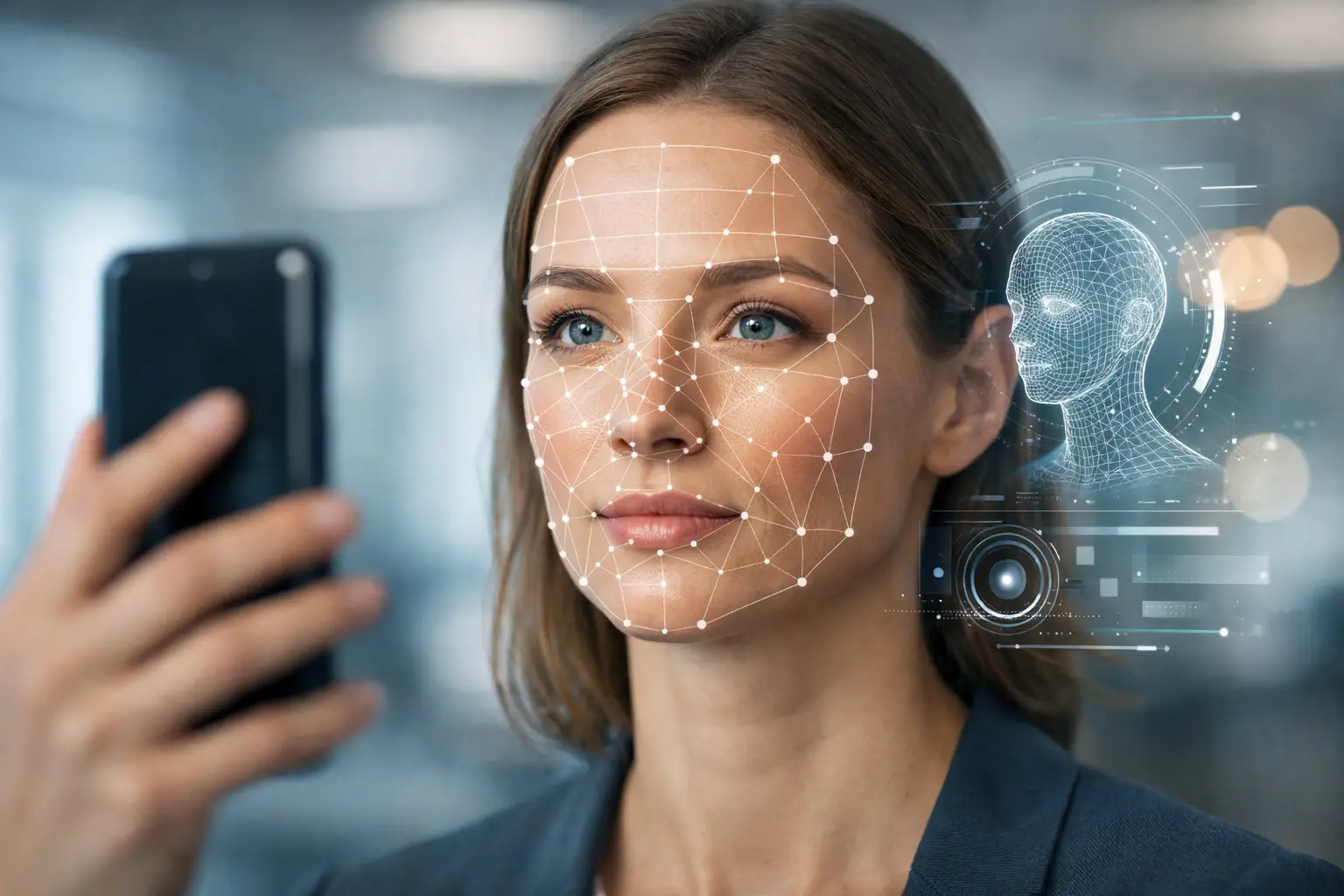
The real question is not just what data does a face scan collect. It is what kind of signal can be extracted from a face, how that signal is structured, and where raw image data ends and higher-level interpretation begins. If you are using a face scan for identity, security, personality analysis, or team insight, that distinction matters.
A modern face scan is not one thing. It is a stack. First comes the visible input - usually a selfie, portrait, or profile image. Then the system identifies facial regions, maps landmarks, measures proportions, and turns visual patterns into machine-readable features. After that, depending on the platform, those features may be used for verification, classification, or broader interpretive outputs.
What data does a face scan collect at the base level?
At the most basic level, a face scan collects image data. That can include a still photo, multiple photos, or video frames if the scan happens live. The system sees pixels first, not personality, intent, or identity. It processes color, contrast, lighting variation, edges, and facial placement within the frame.
That basic layer often includes more than people expect. Along with the visible face, a scan may capture background details, camera angle, image quality, head position, and whether the subject is facing forward or turned slightly to the side. If the scan is done through a phone or browser, technical metadata may also be involved, such as time of capture, device type, resolution, and session markers.
This does not mean every platform stores all of that forever. But it does mean the raw input is often richer than just a cropped image of a face.
Facial landmarks and geometry
Once the image is captured, most systems move to landmark detection. This is where the scan identifies key points on the face - the corners of the eyes, nose bridge, jawline, mouth edges, cheek contours, brow position, forehead shape, and chin structure. Depending on the model, that can mean dozens or even hundreds of reference points.
These points are used to build facial geometry. In practical terms, the system measures distances, angles, symmetry, ratios, and relative positioning. It may compare eye spacing to face width, jaw shape to cheekbone projection, lip proportion to lower-face length, or brow set to orbital depth.
This is where face scans become useful as engines rather than cameras. Geometry gives structure. Structure makes comparison possible. A scan can now move from seeing a face to describing it in a machine-readable format.
For platforms built around interpretation, this structural layer is often the foundation of the entire report. Systems may label it differently - facial mapping, structural integrity, pattern indexing, or neural feature extraction - but the operating principle is the same. The scan converts visible anatomy into analyzable data.
Texture, expression, and presentation cues
Some face scans go beyond shape and measure softer visual cues. That may include skin texture patterns, line distribution, visible tension around the eyes or mouth, expression state, gaze direction, and muscle activation. A security tool might use that information for liveness detection. A face-reading platform may use it to identify emotional patterning or presentation style.
This is where people often confuse collected data with interpreted data. The scan can detect that the brow is raised, the eyes are narrowed, the mouth is compressed, or the face appears neutral. But the meaning assigned to those signals depends on the system and its framework.
That is an important trade-off. More interpretive systems can generate richer outputs, but they also rely more heavily on model assumptions. A scan that says your jawline measures a certain way is reporting a structural observation. A scan that links that structure to decisiveness, emotional reserve, or leadership style is moving into inference.
Biometric identifiers
In many contexts, a face scan collects biometric data. That does not always mean it stores a full face image in plain form. Often, the system converts facial structure into a biometric template - a numerical representation of unique facial features that can be matched later.
This matters most in authentication and identity verification. Instead of saying, "Here is a picture of this person," the system says, "Here is a structured signature built from facial measurements and feature relationships." That signature can then be compared against another scan to see whether they likely belong to the same person.
Biometric templates are sensitive data. They are more durable than a password because you cannot easily change your face the way you change a login credential. So if a platform uses facial data for identity or matching, users should understand whether the system stores raw photos, derived templates, or both.
What data does a face scan collect beyond the face itself?
Many users focus only on the face and miss the surrounding context. In practice, a face scan may also collect operational and behavioral data tied to the scan session. That can include upload history, scan completion time, repeated attempts, image source, and whether the scan passed certain quality thresholds.
If the workflow begins with a name or identifying input, that information may be tied to the scan record. Some platforms also perform profile discovery or image matching to assemble a more complete input set before generating a report. In those cases, the total data picture is broader than facial geometry alone.
For consumer platforms, this broader context can improve output quality. Better image matching, better angle selection, and better signal consistency can lead to more stable analysis. But it also means the scan experience is not just about a single photo. It is about the full chain of data attached to that photo.
Raw data vs inferred traits
This is the line that matters most.
Raw data is what the system directly captures or measures: image pixels, facial landmarks, geometry, visible expression, and technical metadata. Inferred data is what the system concludes from those signals: age band, mood state, attention level, identity confidence, or personality tendencies.
For a general facial recognition tool, inferred output may stop at verification. For an interpretive platform, inferred output can go much further into behavioral and character analysis. That may include emotional patterns, communication tendencies, stress posture, compatibility indicators, or career alignment themes.
A platform like SomaScan.ai is built in that second category. The value is not just in collecting facial data. The value is in translating facial structure and pattern signals into a polished, usable analysis. That is what turns a scan into a report people can act on, share, and use in personal or professional conversations.
Still, users should understand that inference is not the same as certainty. Strong systems can create meaningful pattern reads, but any high-level conclusion depends on methodology, image quality, and how the platform maps physical inputs to interpretive outputs.
What affects the quality of the data?
Not every face scan collects equally useful data. A high-resolution, front-facing image with balanced lighting will usually produce cleaner landmark detection than a dim photo shot from below. Glasses, hair covering the face, strong filters, exaggerated expressions, and motion blur can all reduce reliability.
Multiple images can help. So can profile views, neutral expressions, and better lighting consistency. In professional or report-driven use cases, input quality is often the hidden factor behind output quality. If the source image is weak, even advanced pattern analysis has less to work with.
This is why guided workflows matter. They reduce noise before the engine starts interpreting. Better inputs do not guarantee perfect conclusions, but they give the system a stronger structural base.
Privacy and retention: what users should ask
If you are deciding whether to use a face scan, ask a few direct questions. Does the platform keep the original image? Does it create a biometric template? Is the data used only for your report, or also for model improvement? How long is it retained? Can it be deleted?
Those questions matter whether you are scanning your own face, evaluating compatibility, or using a report in a team context. Facial data is personal. Interpretive outputs can also influence how someone is perceived. So the issue is not just collection. It is storage, reuse, and confidence in the claims built on top of that data.
The strongest platforms make this clear through process design. They do not hide behind vague AI language. They show what the scan is doing, what kind of report it generates, and why the workflow is structured the way it is.
A face scan collects more than an image. It captures structure, signal, and context - then, if the system is built for it, turns that data into a readable pattern model. For users who want fast insight, that can be powerful. The smart move is knowing exactly where measurement ends and interpretation begins.